

If you’re wondering how to do keyword research for a new blog, the hardest part isn’t finding a list of keywords. It’s deciding which topics are actually worth your time.
When I started building AngelinaCH, I quickly realized I could come up with dozens of article ideas. The harder question was whether people were actually searching for those topics—and whether my new site had any realistic chance of being useful in the results.
I want to know something much simpler:
Is this topic worth my time?
The site is still new, so I’m documenting the process as I figure it out rather than pretending I already have a perfect system.
1. Start With a Topic, Not a Keyword
“Blogging” is a topic.
It’s also way too broad.
Nobody searches for something that broad because they have one specific question they need answered. And for a brand-new site, trying to compete for a huge topic like that doesn’t make much sense anyway.
I prefer starting with a problem.
For example, “how to get traffic to a new blog” is a much more useful starting point. It’s specific, there’s an obvious problem behind it, and it’s something I’m actually dealing with while building AngelinaCH.
That eventually became my article on how to get traffic to a new blog in 2026.
So before I open a keyword research tool, I ask myself one question:
What is someone actually trying to figure out?
Once I know that, I can look at how people search for it.
2. Find the Questions Around That Topic
Once I have a problem, I want to see how people actually phrase it.
Google autocomplete is a good place to start. I also check related searches and People Also Ask to see what other questions come up.
Keyword research tools can give me additional ideas and rough search data, but I don’t treat their suggestions as instructions. Forums and communities can be useful too, because people often describe their problems in very different words from the ones used in SEO tools.
The goal isn’t to collect 200 keywords. I want to understand the language around the problem well enough to write something that actually matches the question.
3. Check the Search Results Before You Commit
If I had to keep only one part of my keyword research process, this would probably be it.
I search the phrase myself.
Then I read the results.
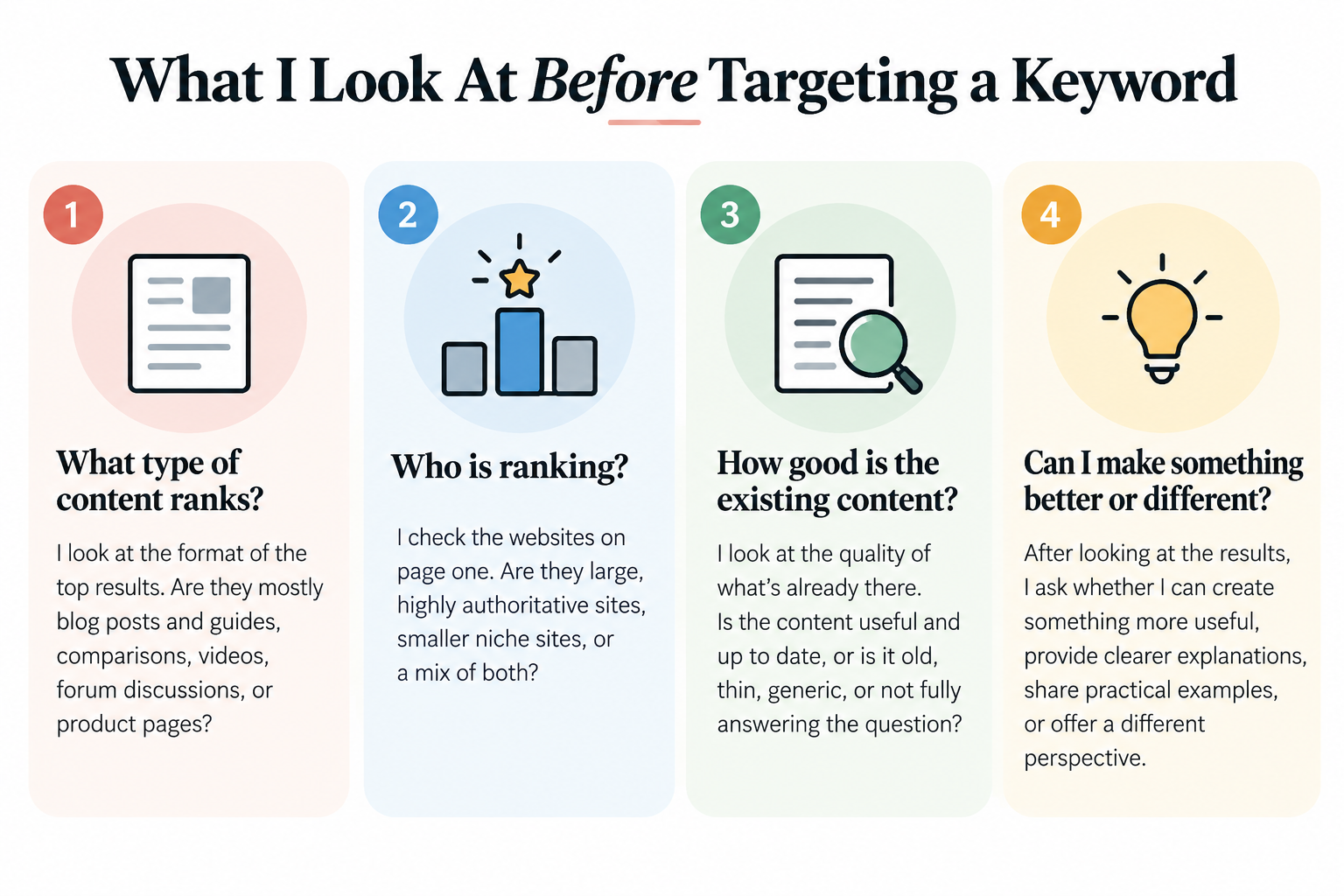
A keyword difficulty score is just a number. The search results show me what that number actually means.
If you want to understand Google’s broader approach to SEO, the Google SEO Starter Guide is a useful reference.
I look at what Google is currently ranking. Are the results mostly detailed guides, comparisons, videos, or forum discussions? Who is ranking — huge established sites, smaller sites, or a mixture of both?
I also look at the quality of what’s already there. Is the content useful and current, or is it old, thin, or generic?
And finally, I ask whether I could realistically make something more useful or at least different.
Sometimes a keyword looks difficult on paper but the actual results are surprisingly weak. Other times, the opposite is true.
This is one of the most useful parts of how to do keyword research for a new blog: looking at the actual results before deciding what to write.
That’s why I don’t want a tool making the decision for me.
4. Don’t Treat Search Volume as the Whole Answer
Search volume is tempting because it’s simple. You get a number, and bigger looks better.
When you’re learning how to do keyword research for a new blog, search volume can be useful, but it shouldn’t be the only thing guiding your decision.
But a high-volume keyword can also mean heavy competition, unclear intent, a first page dominated by major sites, or an answer Google can provide without requiring a click.
A more specific search can sometimes make more sense for a new site because it matches a clearer problem. That doesn’t mean low volume is automatically better either. A keyword nobody searches for isn’t useful just because it’s easy to rank for.
For me, search volume is one signal among several. I also care about relevance, intent, competition, what’s currently ranking, and whether there’s actually a reason for someone to click.
5. Search Intent Matters More Than the Keyword Itself
Search intent sounds more complicated than it is.
It’s basically asking:
Why did this person search for this?
Someone searching “what is keyword research” probably wants an explanation. Someone searching “best keyword research tool” is more likely comparing options before deciding what to use. And someone searching for a specific company name may simply be trying to reach that company’s website.
SEO people usually divide these into categories like informational, commercial, navigational, and transactional. Those labels are useful, but I don’t need to overthink them.
I just ask:
What does this person actually want?
Then I ask whether the article I’m planning gives them that.
The search results usually give me a clue. If Google is showing mostly step-by-step tutorials and I’m planning to write a personal opinion piece, there’s probably a mismatch.
The results are telling me what searchers expect, so I should pay attention.
6. What Changes When AI Search Enters the Picture?
Search in 2026 isn’t just a list of ten blue links anymore.
There are AI-generated answers, AI search features, and searches where someone gets enough information directly on the results page that they don’t need to visit another website.
I’m not going to pretend I know exactly what that means for a site as small as AngelinaCH. I don’t think AI search automatically means organic traffic is going away either. Google’s own documentation says standard SEO best practices still apply to its AI features.
What I take from that is pretty simple:
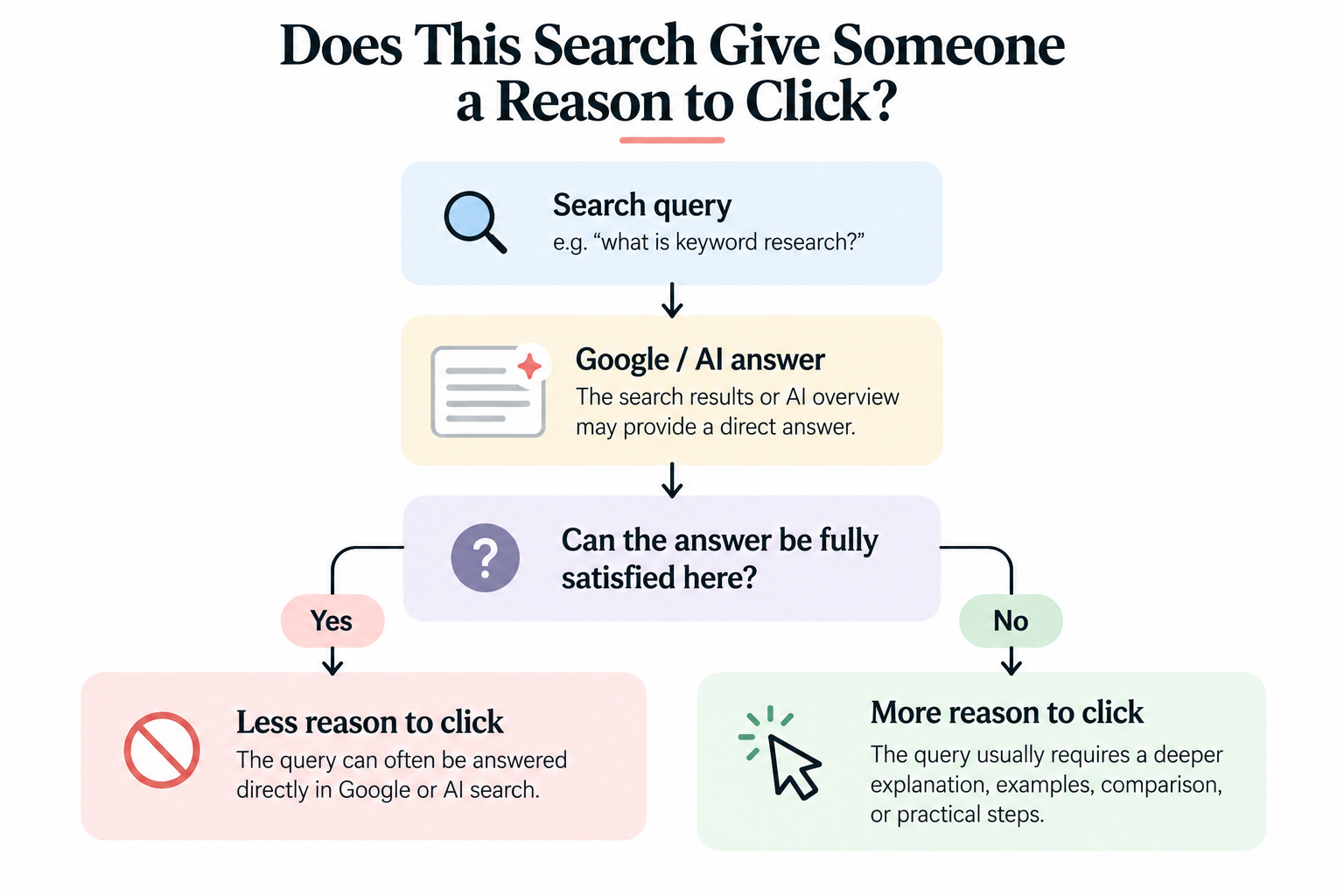
Not every search is equally likely to produce a website visit.
A high-volume query that can be answered in one sentence might generate plenty of searches but give people very little reason to click.
Questions that require examples, comparisons, practical instructions, or real experience are different. There’s more value in clicking through to something deeper.
So one question I’m starting to ask during keyword research is:
Does this search give someone a reason to leave the results page?
I’ve written more about what AI search is and what it means for bloggers and how to optimize content for AI search, so I won’t turn this article into another AI-search guide. Here, I’m treating it as one more factor when deciding what deserves my time.
7. How Keyword Research Turns Into Content Topics
A lot of searches are really the same need phrased in different ways. Writing a separate thin post for every variation just makes the site harder to manage.
I think about how the topics fit together on AngelinaCH. Blogging is the broader subject, with areas like AI for blogging, SEO, keyword research, traffic, and making money from a blog.
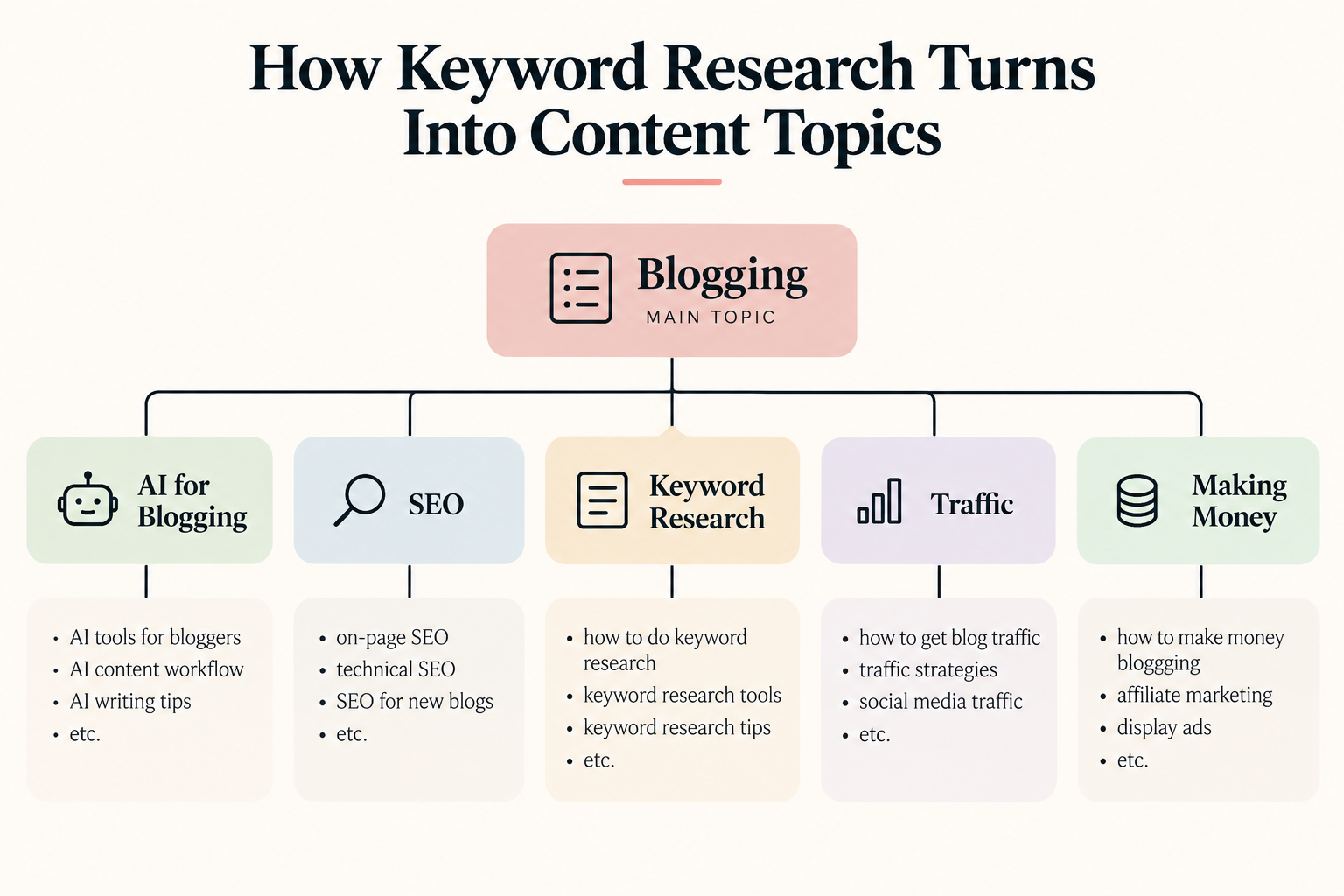
This article connects with my article on getting traffic to a new blog, which connects with how to make money blogging.
Grouping topics this way helps me decide whether something deserves its own article or belongs inside something I’ve already written.
This is one reason how to do keyword research for a new blog isn’t just about finding individual keywords. It’s about understanding which searches belong together and which topics deserve their own content.
8. Turn Keyword Research Into a Content Decision
The goal isn’t to come away with 100 keywords.
It’s to find a topic that’s relevant to my site, matches a real question, has an intent I understand, and gives me something useful to contribute.
This is where how to do keyword research for a new blog becomes less about collecting keywords and more about making content decisions.
Before I write, I want to answer five simple questions:
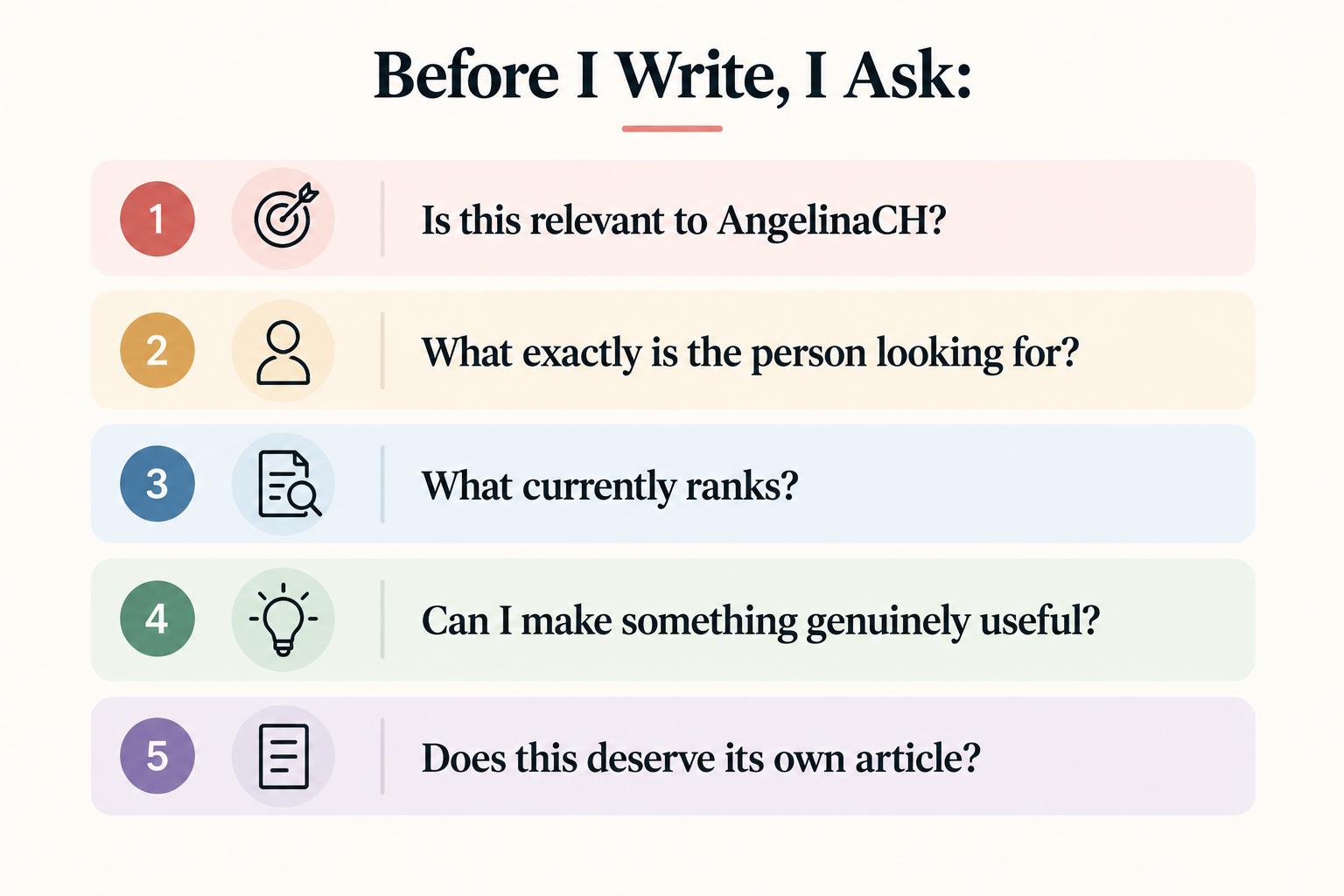
That’s how I’m approaching keyword research on AngelinaCH. I’m starting with problems I’m actually working through, studying how people search for them, and then comparing that with what’s already ranking. I don’t have enough results yet to claim a proven system, so I’m testing what works and letting the data shape what I do next.
FAQ
What is keyword research?
Keyword research is the process of finding what people search for around a topic and deciding which searches are worth creating content for.
How do I find keywords for a new blog?
Start with a specific problem. Use autocomplete, related searches, People Also Ask, and the actual search results to find and evaluate possible topics.
What keywords should a new blog target?
Look for topics that are relevant to your site, have a clear intent you can satisfy, and have results you could realistically compete with. Specific questions can be a sensible starting point, but there isn’t one rule that works for every new blog.
Do I need a paid keyword research tool?
I haven’t tested this enough to give a firm answer for AngelinaCH. Right now, free sources like autocomplete, related searches, and People Also Ask give me plenty to work with.
A paid tool may become more useful as the site grows. I just don’t see a reason to pay for more information before I know what I’ll actually do with it.
Is keyword research still useful with AI search?
Yes. Understanding what people ask and what they need still matters. The extra question is whether a search gives someone a reason to click through to a website.
Keyword Research Isn’t About Finding the Perfect Keyword
It’s about guessing less before you spend hours writing.
Starting with a real question, checking the intent, and actually reading the search results gives me more information than choosing a keyword because it has a big number next to it.
That’s enough for me to start.
And then I can see what happens.