

So, how do you optimize content for AI search without chasing every new SEO trend? That’s what we’ll get into here.
Some of it is genuinely new. A lot of the rest is existing SEO advice wearing a new acronym. If you’ve read our pieces on what AI search actually is, GEO, and SEO vs AEO vs GEO, you know the theory. This article skips the definitions and gets into what to actually do.
How to Optimize Content for AI Search
In practical terms, it means making your content easier to discover, understand, and use — for whoever, or whatever, is reading it. There’s no separate AI-only version of good content. That comes down to a handful of things:
- Content that’s discoverable — crawlable, indexable, structured in a way search systems can parse
- Content that’s understandable — clearly written, not buried under filler
- Content that’s useful — it actually answers the question someone came with
- Content that’s trustworthy — claims are backed up, experience is real
- Content that’s relevant — it matches what the reader is trying to figure out
None of this guarantees an AI Overview citation or a mention in a ChatGPT answer. What it does is put your content in the pool of pages eligible to be picked up, which is the part actually within your control.
Does AI Search Require a Different SEO Strategy?
No. Traditional SEO fundamentals are still the foundation. Google’s documentation on generative AI features states that its AI-powered search experiences are built on its existing Search ranking and quality systems. There isn’t a separate set of AI-only SEO fundamentals you need to master alongside regular SEO.
That doesn’t mean nothing has changed — AI features can summarize and synthesize in ways a traditional results page doesn’t. But the steps below are SEO fundamentals, applied with more intention, not AI-specific tricks.
1. Start With the Question Your Content Actually Answers
Before anything else, get specific about what your content is actually for.
Weak: “AI search”
Better: “How do I optimize my blog for AI search?”
The first is a topic. The second is a question a real person would type or ask. Content built around a specific question is clearer and easier for both readers and search systems to evaluate. This isn’t a full keyword research lesson — it’s a reminder to write toward an actual question, not a vague theme.
2. Answer the Main Question Clearly
Once you know the question, make sure the answer isn’t buried:
- A clear, direct opening that addresses the question early
- Short, focused sections instead of one long wall of text
- Lists where a list genuinely helps, not because lists look “SEO-friendly”
One thing worth being direct about: there’s no magic word count for an AI-friendly answer. You’ll see guides claiming answers need to be exactly 40 to 60 words, or some other specific number. There’s no solid evidence behind that. Write the answer at the length it actually needs.
3. Use Clear Structure and Descriptive Headings
Headings should tell a reader — or a skimming search system — what a section covers, without them having to read it first.
Vague: “More Thoughts” Descriptive: “Does AI Search Require a Different SEO Strategy?”
Organize logically, keep sections short, and use tables or lists where they actually clarify something. This is primarily good writing and good user experience — not an “AI hack.”
4. Add Something Original
Probably the most important part of learning how to optimize content for AI search.
There are a lot of generic articles about most blogging topics already. If yours doesn’t add anything beyond what a dozen other pages say, there’s not much reason for a search system — or a reader — to prefer it. Original value can come from:
- First-hand experience with a tool, process, or platform
- Screenshots of something you actually did
- A real comparison based on actual use, not assumptions
- An experiment, with results you actually observed
- Mistakes you made and what you learned from them
Instead of writing another generic article about starting a blog with AI tools, show what happened when you actually built one — what worked, what didn’t, what surprised you.
Don’t invent first-hand experience you don’t have. If you haven’t tested something, say so, and write honestly about what you do know.
5. Support Important Claims With Good Sources
If you’re stating a fact, especially one that could be wrong or outdated, back it up.
Unsupported: “AI search has completely changed how people find information.” Sourced: Google’s documentation explains how its AI search features can surface links to supporting sources.
Prefer primary sources — official documentation, original research, the platform’s own guidance — over secondhand summaries of what someone else claimed a study said.
6. Build Related Content, Not Hundreds of AI Pages
Topical depth helps readers explore a subject and gives your site genuine coverage of it. A small, sensible cluster on a topic like AI search might look like:
- AI Search: What It Is
- What Is Generative Engine Optimization (GEO)?
- SEO vs AEO vs GEO
- How to Optimize Your Content for AI Search
Four solid, distinct articles that link to each other naturally. What you don’t want is dozens of thin variations chasing every possible AI prompt — beyond being a poor reader experience, that kind of scaled, low-value content can run into the same spam and quality problems as any other low-value content.
7. Keep Your Site Technically Accessible
The basics still matter: crawlable, indexable, working internal links, usable on mobile, reasonable page experience. You don’t need a special AI version of your website — normal technical SEO does the job here too.
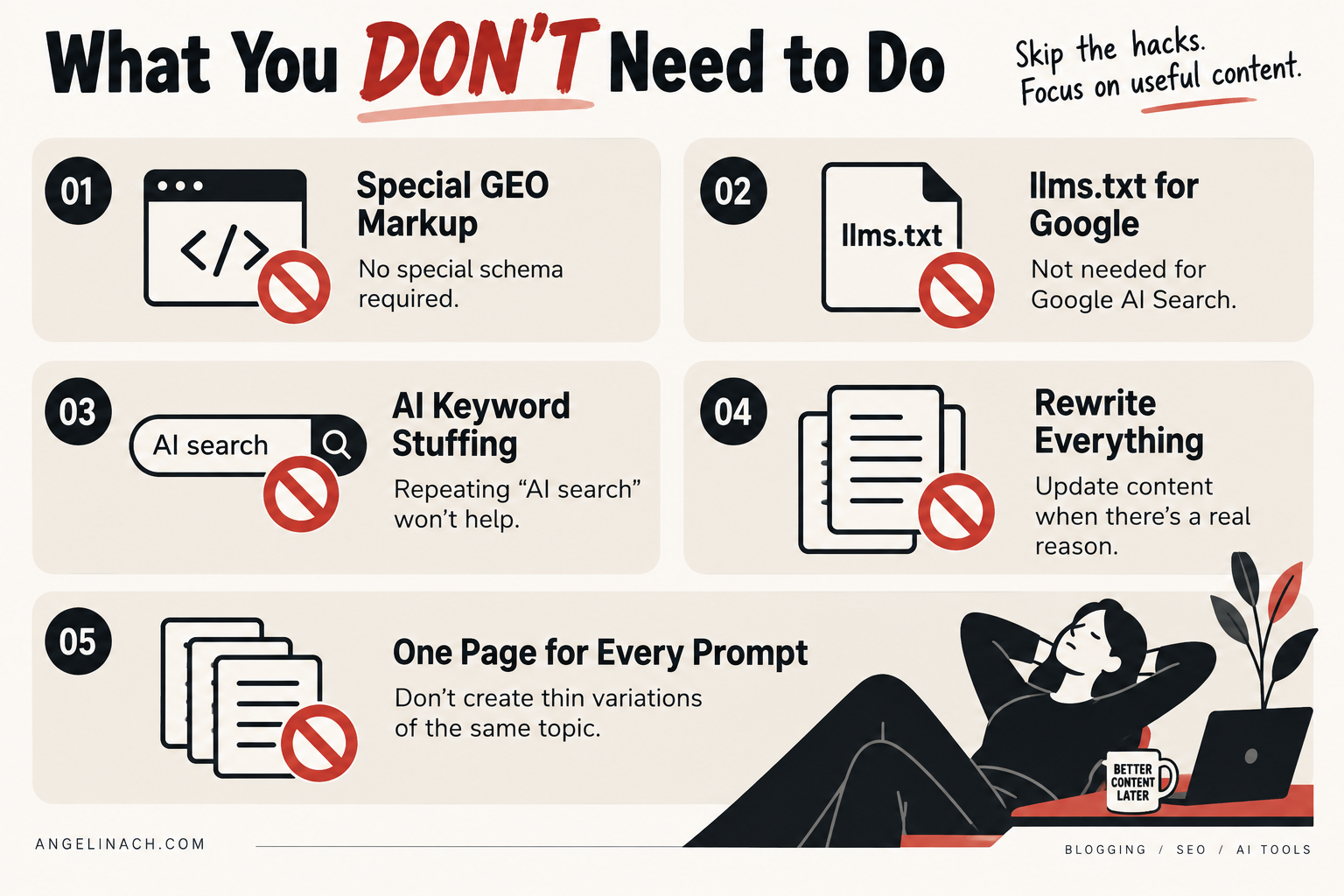
What You DON’T Need to Do
Not every AI-search tactic is worth your time. Many so-called GEO hacks add complexity without improving visibility. In most cases, you’re better off focusing on useful content, clear structure, and solid SEO fundamentals than chasing every new AI optimization trend.
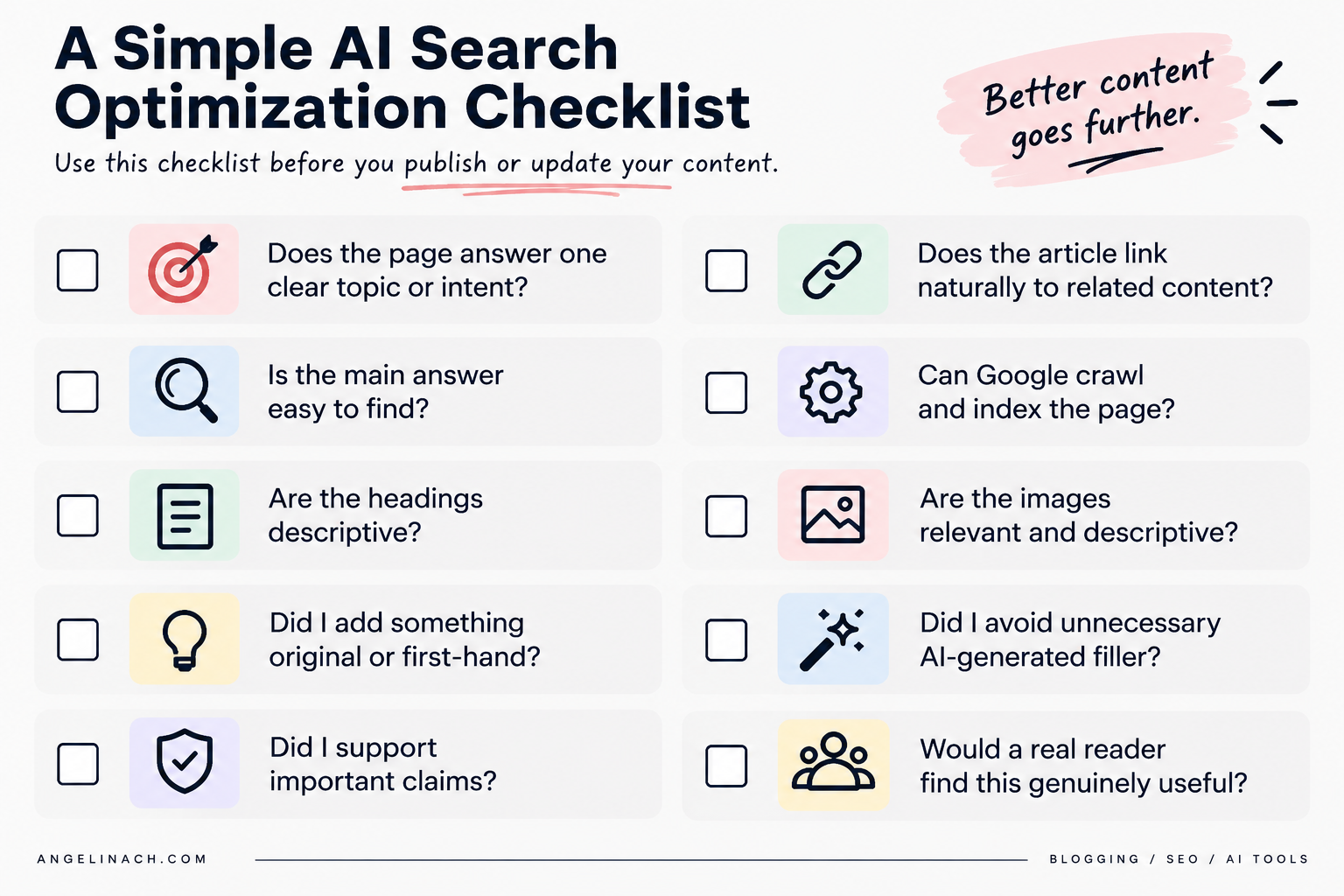
A Simple AI Search Optimization Checklist
Use this quick checklist when you optimize content for AI search. It won’t guarantee AI visibility, but it can help you catch the basics that make content clearer, more useful, and easier to discover.
How Do You Know If It Worked?
Measurement here is mostly the same tools you already use. Google Search Console remains the main source for impressions, clicks, queries, and average position — it also offers a generative AI performance report where available, giving some visibility into how content performs within Google’s AI features specifically.
Beyond that, watch organic traffic overall and, where identifiable, any referral traffic from AI platforms. Some bloggers manually check whether their content shows up in AI Overviews or AI Mode for relevant queries, though that kind of spot-checking is inconsistent and never guaranteed.
FAQ
Does AI search replace SEO? No. AI features are built on existing search infrastructure, and standard SEO fundamentals remain the foundation for visibility in both traditional and AI-driven results.
How do I optimize my blog for AI search? Write clear, original, well-structured content that answers a specific question directly, is backed by real sources or experience, and sits on a technically healthy site.
Can AI search optimization guarantee citations? No. Nothing can guarantee a citation, a mention, or inclusion in an AI-generated answer. The goal is to make your content eligible to be picked up, not to force it.
Bottom Line
AI search doesn’t require bloggers to abandon SEO and learn an entirely new system. The fundamentals are the same ones you already know: answer clearly, add something original, support your claims, keep your site technically accessible.
What’s changed is how content gets used once it’s found — as a traditional result, a direct answer, or part of an AI-generated response. Getting there is still just good content and good SEO.