

A content strategy for a new blog helps you decide what is worth publishing when you have more possible topics than you have time to cover. The challenge isn’t finding another idea. It’s deciding which ideas belong on your site, which should come first, and how they should connect.
A content calendar tells you when to publish. A strategy helps you decide what deserves to be published, why it belongs on your site, and what you should create next.
1. Build Your Blog Content Strategy Around Core Topics
Three terms are often used interchangeably, but they serve different purposes:
- Strategy is the decisions behind the content: who the blog is for, which subjects it covers, what gets priority, and what gets left out.
- Content plan is the list of articles you intend to create based on those decisions.
- Editorial calendar is when you intend to publish them.
A calendar can be filled with almost anything. Without a strategy behind it, you can end up publishing consistently without building a useful body of related content.
2. Start With Your Audience
Topic selection should start with the reader, not with a keyword list.
- Who is this blog for?
- What are they trying to get done?
- What keeps getting in their way?
- What would genuinely help them?
- What subjects should a visitor expect you to cover?
You don’t need an elaborate persona for this. A simple description of the reader and what they need is often enough to filter ideas. If a blog helps people start a food blog on a budget, an article about choosing a first domain name may fit. A detailed guide to enterprise email automation probably doesn’t.
The clearer the purpose, the easier it becomes to decide which ideas belong on the site and which don’t.
3. Choose Core Topics for Your Blog Content Strategy
Core topics, often called content pillars, are the broad subject areas your blog intends to cover in depth. A food blog for beginners on a budget might focus on cheap weeknight meals, kitchen basics, and meal planning.
For a new site, focus matters because depth is difficult to build when your attention is scattered. A blog with two articles each on fifteen unrelated subjects has no clear area of depth. A blog with a dozen connected articles on one subject area gives readers a stronger reason to explore further and makes the site’s topical focus clearer.
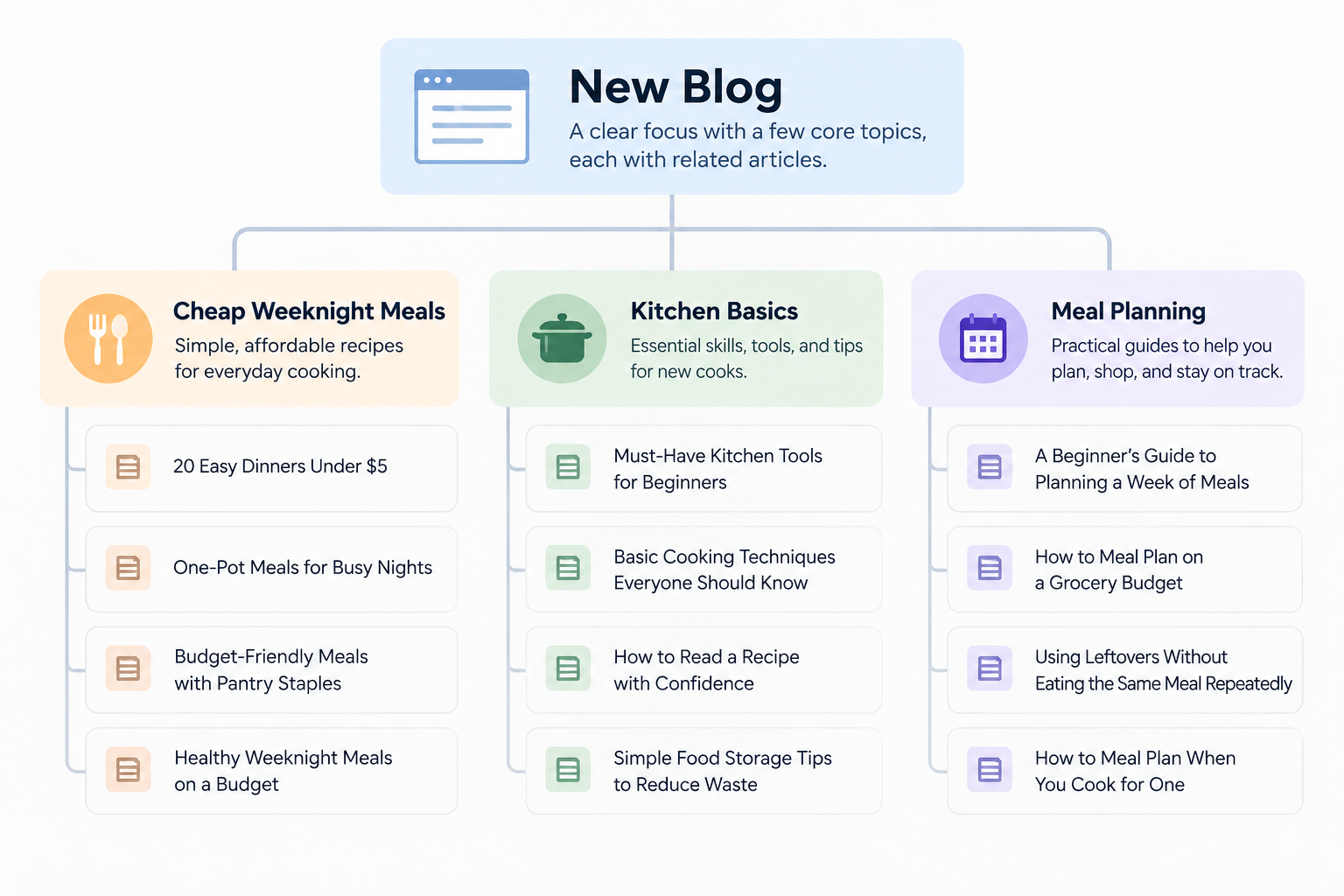
There is no correct number of pillars. Some blogs need two and some need five. The better test is whether a topic serves the readers you’ve described, whether you can cover it with real knowledge or proper research, whether it can support several genuinely different articles, and whether you’ll still want to write about it a year from now.
4. Build Topic Clusters
A topic cluster is a group of related articles built around one core topic. It usually has a broader foundational article and several narrower ones that each solve a specific problem, all linked together.
Take a pillar like “meal planning.” The foundational article might be a beginner’s guide to planning a week of meals. Around it you could build:
- How to plan meals around a grocery budget
- How to use leftovers without eating the same dinner three days in a row
- How to meal plan when you cook for one
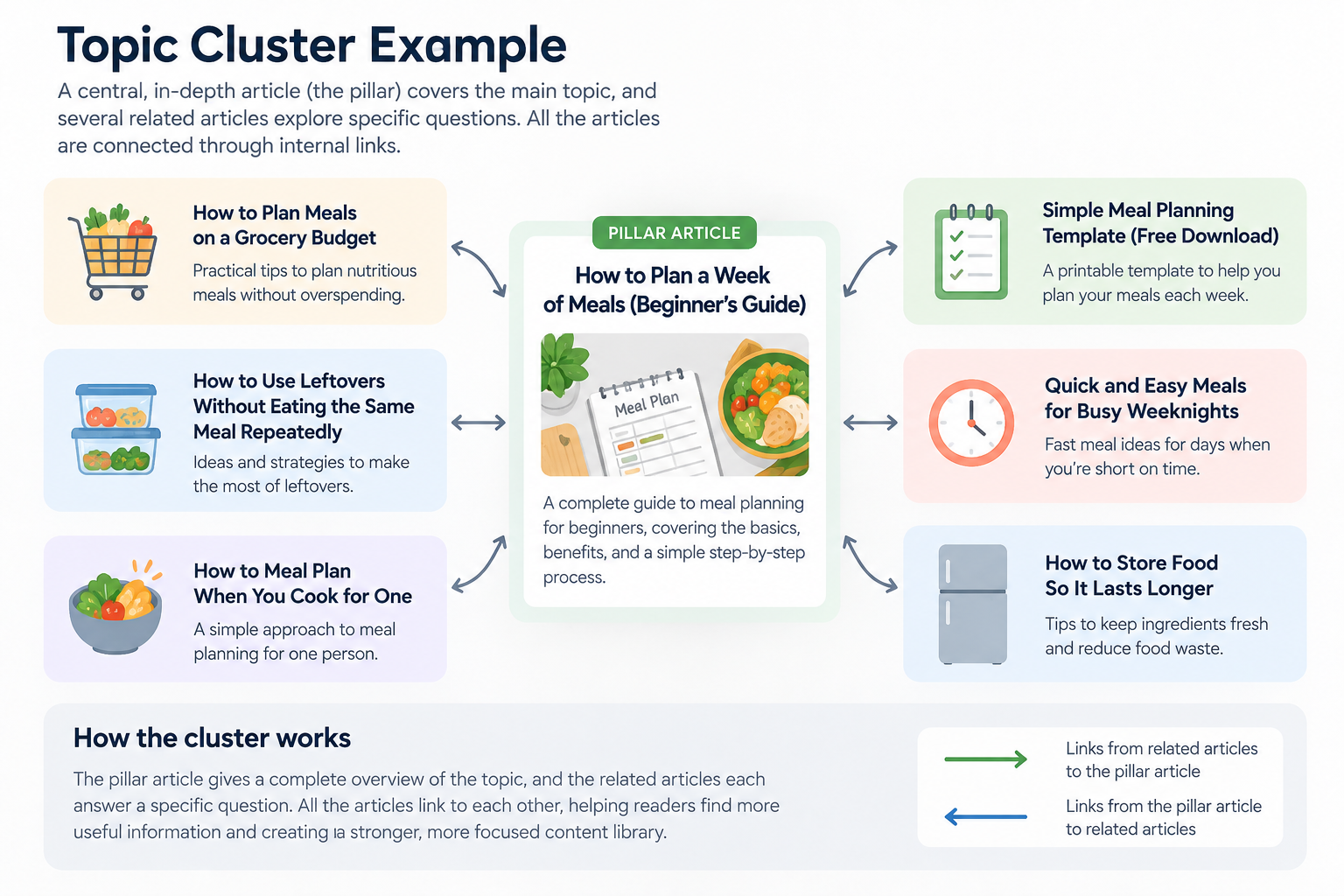
Each article answers a distinct question within the same subject, creating a connected body of content rather than a collection of isolated posts.
Every article in a cluster needs a reason to exist. Not every keyword variation does. “Easy meal plan for beginners” and “beginner meal planning guide” are almost certainly the same search intent. Two separate articles would compete with each other and split your effort. One strong article covering that intent is usually better than two thin ones.
When you’re unsure, search both phrases. If the results are nearly identical, they may represent the same topic rather than two separate articles.
Internal links
Internal linking helps connect related articles as your content library grows. When you publish a new article, link to relevant existing content where it helps the reader. When a new article becomes useful to an older one, go back and add that link.
You don’t need a perfect site map before you begin, but avoid leaving useful articles isolated. Every internal link should have a reason to be there.
5. Use Keyword Research to Validate Topics
Keyword research is useful, but it’s an input to your strategy, not the strategy itself. It can show you how people phrase a problem, what related questions they ask, whether a topic has search demand, and where existing results may leave gaps.
What it can’t decide is whether a topic belongs on your blog. A high-volume keyword that has nothing to do with your audience is still a poor fit. A narrower topic with modest demand may be worth covering if it solves an important problem for your readers.
Use keyword research to validate and sharpen your ideas rather than generate a random list of phrases to chase. Our guide on how to do keyword research for a new blog in 2026 covers the process in more detail.
6. Check Search Intent
This step saves more wasted effort than any other. Before you write an article, search for the phrase and look at what comes up. Ask:
- What types of pages are ranking? Guides, product pages, category pages, videos, forum threads?
- What questions are they answering? What do the top results all seem to cover?
- What is the intent? Is the searcher trying to learn something (informational), compare options (commercial), buy (transactional), or reach a specific site (navigational)?
- How deep does the topic need to go? Quick answers, or long walkthroughs?
- Is a blog article even the right format? Sometimes the results are all tools, templates, or product listings.
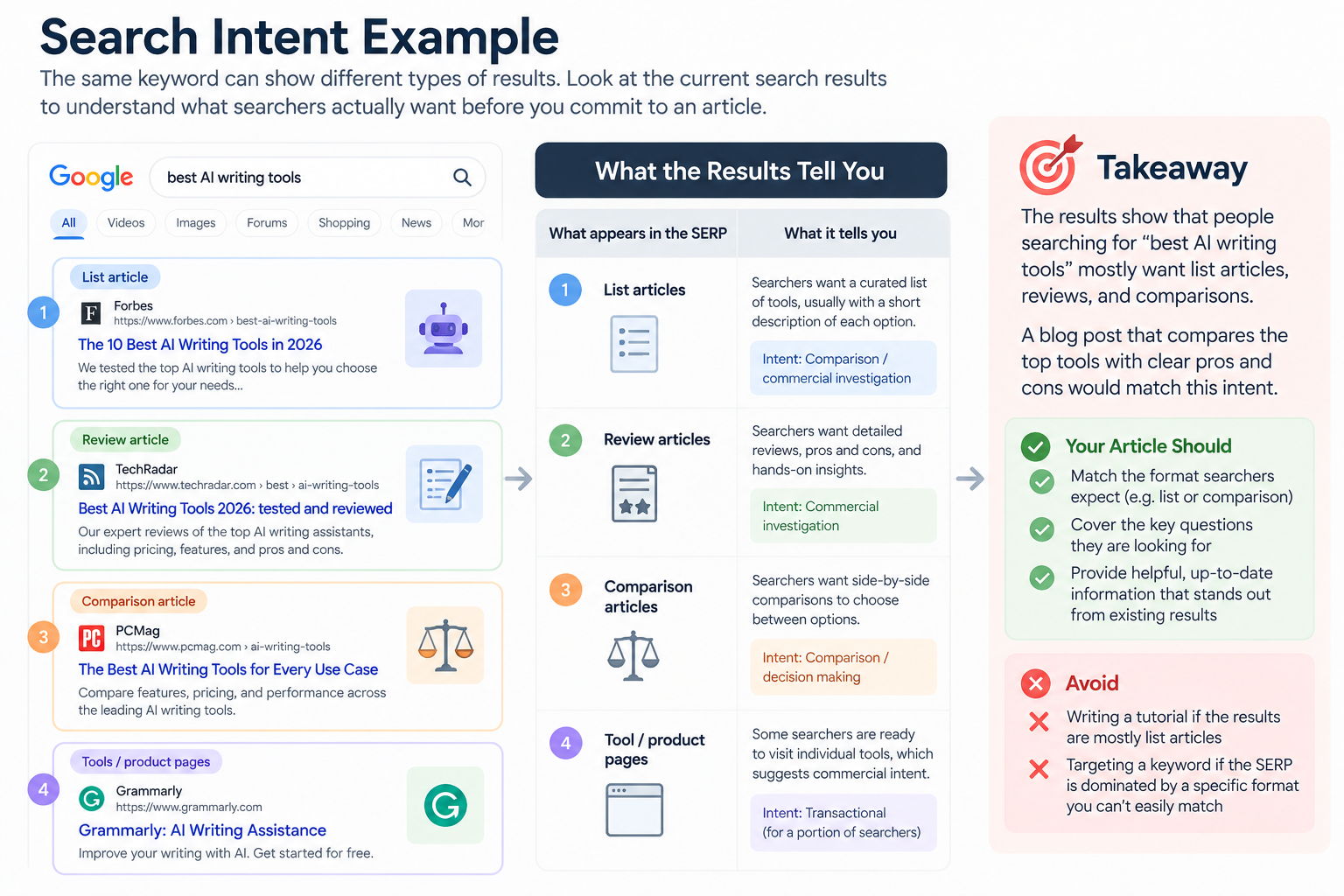
A keyword can look attractive in a research tool and still be a poor fit. If every result is an online calculator, for example, a 1,500-word article probably isn’t what searchers expect. If the results are dominated by comprehensive guides, you may need a narrower angle or more supporting content before targeting the broader topic.
Search intent is ultimately a question of fit: can you give searchers what they came for, in the format and depth they expect? Once the topic passes that check, how to write an SEO blog post in 2026 covers how to turn it into an article.
7. Prioritize What to Publish
You don’t have to publish ideas in the order you thought of them. Prioritizing them means looking at how relevant they are to your readers, how well they fit your core topics, whether the search intent is something your site can satisfy, and whether you can answer the question accurately and usefully. It also helps to consider whether the article will support other content through internal links, whether it connects naturally to the site’s eventual business goals, and how much effort it will take to produce well.
You could turn these factors into a scoring formula, but numbers can create a false sense of precision. What matters most will change as the site grows. Early on, it often makes sense to build one foundational article for a core topic and a few narrower articles that support it.
Some topics should wait. A broad, competitive topic may make more sense after you’ve built supporting content around it. Waiting is a decision, not a failure.
8. How Often Should You Publish?
There’s no universal publishing frequency that guarantees results. The right pace depends on how long your topics take to research, write, and edit, how much time you have, and whether you can maintain quality.
A schedule you can sustain for a year is more useful than a burst of daily publishing that ends after a month. Consistency should mean consistently useful output, not maximum output.
This lines up with Google’s guidance on creating helpful, reliable, people-first content, which says content should primarily be created to help people, not to attract search traffic. Choose a pace that lets you meet that standard.
9. Use Search Data to Refine Your Strategy
A new blog’s early data will probably look underwhelming. You may see impressions with few or no clicks, rankings far down the results, positions that jump around, queries you never targeted, and very little traffic overall.
Look for patterns rather than individual numbers. Your early data can show which topics your pages are beginning to be associated with, which subjects are getting more visibility, and whether there are queries that deserve a deeper or more focused article. It can also reveal where a page may not quite match search intent or where a clearer title and structure could help.
Google’s Search Console Performance report is where you’ll see most of this. Be cautious with small numbers: a handful of impressions on a handful of pages doesn’t tell you much. The data gets more reliable as the site grows. And impressions don’t automatically turn into rankings or traffic, so treat them as clues, not promises.
The point of a content strategy for a new blog is to let evidence adjust your plan. If one cluster is gaining visibility, it may be worth deepening. If an article attracts the wrong kind of query, its intent may need revisiting.
10. When to Update Older Posts
Updating is part of a content strategy, but it should have a clear reason. Revisit an article when the information is out of date, when it no longer matches what searchers are looking for, when there’s useful new information to add, when newer articles create better internal-linking opportunities, or when the structure has obvious weaknesses. Search data can also reveal a meaningful opportunity to improve an existing post.
Don’t rewrite an article simply because it’s old. Age alone isn’t a reason to replace good content. A clear, accurate piece that still answers the question well can stay as it is. Constant rewriting also takes time away from making new things that fill real gaps.
Common Content Strategy Mistakes
- Publishing whatever comes to mind. Without a clear filter, the site can drift across unrelated subjects.
- Treating keyword research as the strategy. A keyword list doesn’t tell you what belongs, what comes first, or how articles should connect.
- Creating too many unrelated topics. Trying to cover everything makes it harder to build depth anywhere.
- Writing multiple articles for the same search intent. Slightly different keyword phrases don’t always justify separate posts.
- Publishing or rewriting simply to stay busy. More activity isn’t necessarily better strategy.
Frequently Asked Questions
What is a content strategy for a new blog?
It’s the set of decisions about who the blog serves, which topics it covers, what gets published first, and how the articles connect. It guides the content plan and editorial calendar.
How many content pillars should a new blog have?
There’s no fixed number. Choose as many as you can cover with real depth, which for many new blogs means a small handful. If you can’t see a subject supporting many distinct articles, it may not be a pillar.
How often should a new blog publish?
There’s no universal number. Publish at a pace you can sustain while maintaining the quality of your research, writing, and editing.
Should I update old blog posts or create new ones?
It depends on what’s weak. If an old article is outdated or misses what searchers want, improve it. If there’s a gap in your coverage, write something new. Doing both over time is normal.
Final Thoughts
A content strategy for a new blog isn’t about producing the maximum number of articles. It’s about deciding what belongs on the site, how topics connect, what deserves priority, and what the data tells you to do next. Start with a clear purpose, build a focused group of related articles, and let what you learn shape the next part of the plan.