
If you’ve been reading about SEO lately, you’ve probably run into two new acronyms: AEO and GEO. Suddenly it isn’t enough to just rank in Google. Apparently you also need to think about answer engines, generative engines, and AI search, all with their own three-letter names.
The reality is less complicated than the acronym soup makes it look. SEO, AEO, and GEO overlap a lot more than they diverge. The real question isn’t “which one should I do,” it’s “which search experience am I thinking about when I write this.” Once that clicks, the rest gets a lot easier.
This article walks through what each term actually means, where they overlap, and what that means for a blogger who just wants their content to get found — by people, by Google, and increasingly by AI systems summarizing the web for them.
1. What Is SEO?
SEO stands for Search Engine Optimization. In the broadest sense, it’s the practice of making a website and its content easier for search engines to discover, understand, evaluate, and eventually show to the right person.
It’s more than “keywords and backlinks,” even though that’s the shorthand people reach for. Good SEO covers things like:
- Understanding what someone actually wants when they search a phrase
- Writing content that’s genuinely useful, not just keyword-adjacent
- Making sure your site is crawlable and indexable
- Structuring pages with clear headings and internal links
- Keeping the technical foundation healthy — fast pages, working links, no broken redirects
- Building trust through accurate, well-sourced information
The traditional goal of SEO is to help relevant pages appear in search results, where people can discover and visit them.
2. What Is AEO?
AEO stands for Answer Engine Optimization. It’s a term people use to describe optimizing content for answer-oriented search experiences — situations where someone might get a direct answer instead of a list of ten blue links to sort through.
Think featured snippets, “People also ask” boxes, voice search results, or any surface where the goal is giving someone a clear answer quickly rather than sending them off to browse.
Worth saying clearly: AEO isn’t an official Google ranking system with its own algorithm. It’s industry shorthand for a goal — answering questions clearly enough that a search system can lift the answer out and show it directly. The terminology isn’t standardized, and you’ll see different marketers define it slightly differently.
3. What Is GEO?
GEO stands for Generative Engine Optimization. It describes the idea of improving the odds that your content gets discovered, represented, or cited when an AI system generates an answer — think AI Overviews, AI Mode, or a chatbot summarizing a topic for someone.
If you’re new to AI search itself, see AI Search: What It Is, How It Works, and What It Means for Bloggers for the broader picture.
Like AEO, GEO overlaps heavily with SEO rather than replacing it. It’s not a separate technical ranking system, and no tactic guarantees a citation, a mention, or referral traffic from an AI answer. If you want a deeper explanation of what actually seems to help, we covered that in What Is Generative Engine Optimization (GEO)? — this article stays focused on how the three terms relate to each other.
4. SEO vs AEO vs GEO: What’s Actually Different?
Here’s a simple way to compare them side by side.
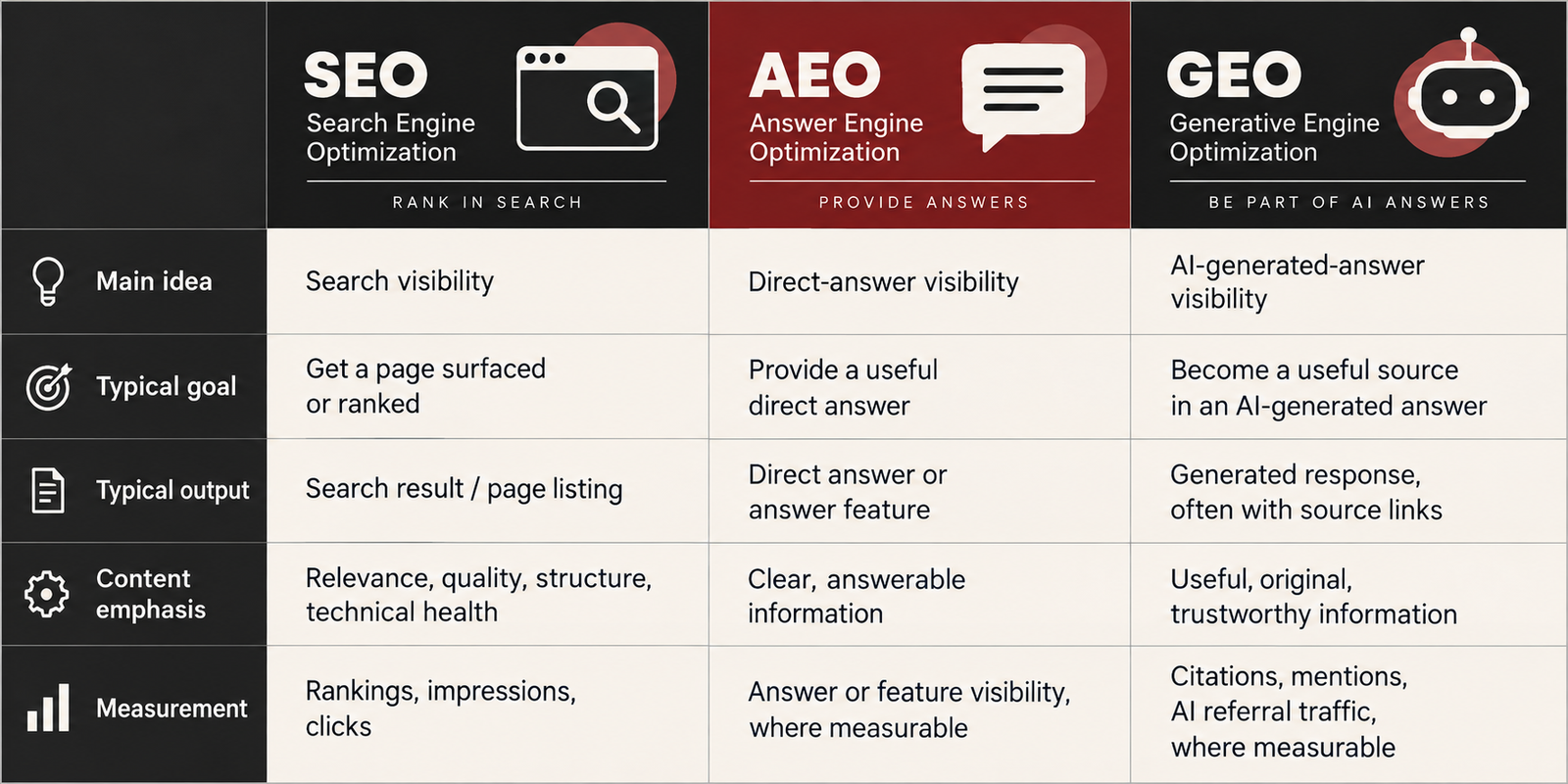
The table makes them look like three separate columns, and in a narrow sense they are — each one describes a different kind of search result. But that’s exactly where people get tripped up. These aren’t three technical categories that require three separate content strategies. A single well-written article can serve all three at once, because the underlying work — answering the question clearly, backing it up, structuring it well — is the same work either way.
5. Are AEO and GEO Actually Different From Each Other?
Honestly, this depends on who you ask. Some marketers draw a clean line: AEO is about answer-based search in general, GEO is specifically about generative AI. Others use the two terms almost interchangeably. There’s no universal, agreed-upon boundary, and the terminology is still shifting as the industry figures out what to call this stuff.
For this article, we’re using a practical working distinction: AEO covers optimizing for direct-answer experiences broadly, and GEO covers optimizing specifically for visibility in generative AI answers. That’s useful for discussion — it’s not a formal technical boundary, and you shouldn’t treat it as one.
Google’s own Search Central guidance makes a similar point: optimizing for its generative AI search features still relies heavily on the same SEO fundamentals used elsewhere in Search.
6. Do You Need to Choose Between SEO, AEO, and GEO?
No. This is probably the most useful thing to take away from this article.
You don’t need one SEO strategy, a separate AEO strategy, and a third GEO strategy running in parallel. That’s a recipe for burnout and confusion, not better content. The fundamentals overlap so heavily that a single workflow can cover all three:
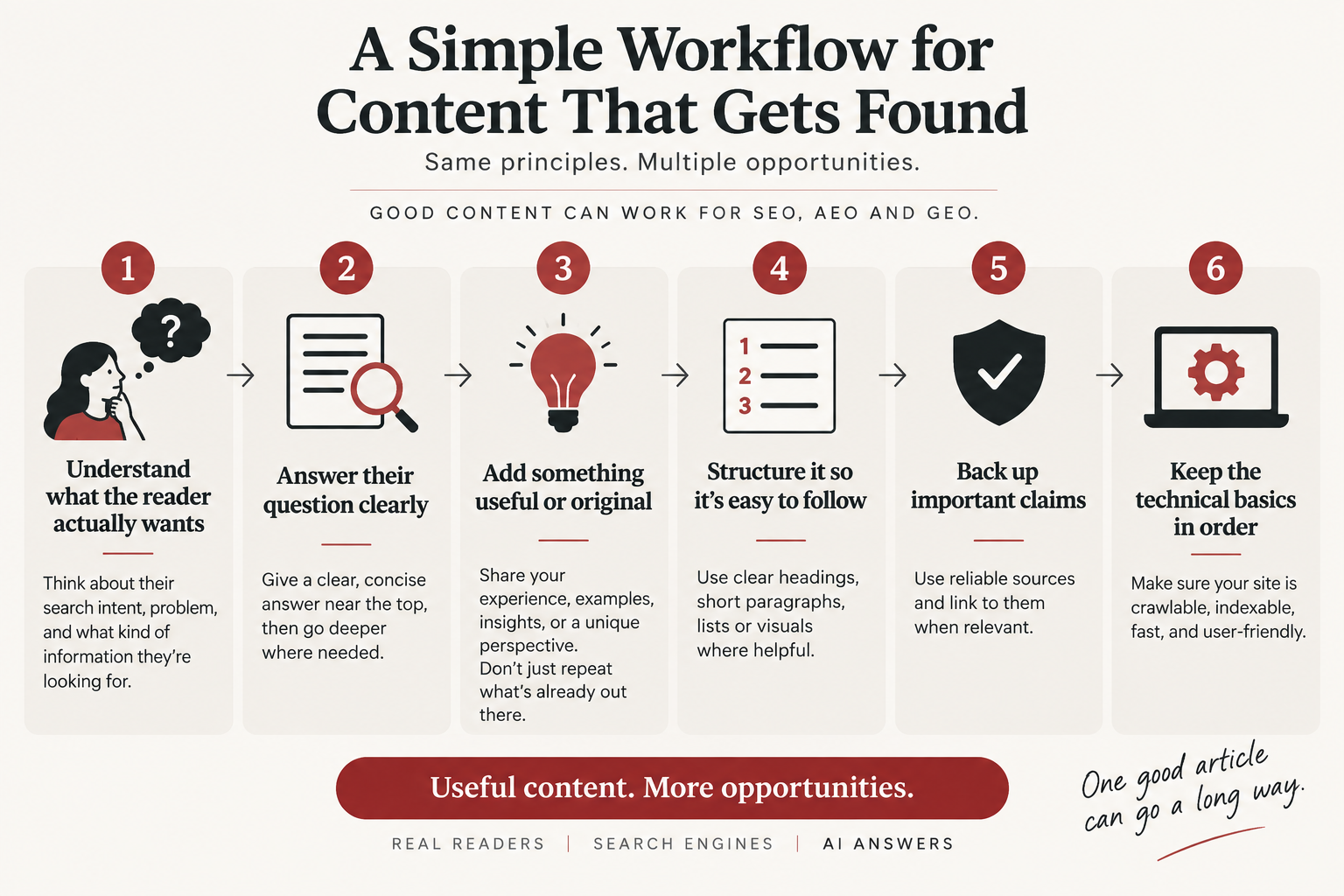
Google’s current guidance backs this up. SEO best practices remain relevant to AI Overviews and AI Mode, and Google says there are no additional technical requirements specifically required for appearing in those features.
7. What Should Bloggers Actually Focus On?
Keep it practical:
Write for real readers. Not for a hypothetical algorithm or a checklist. If it wouldn’t help an actual person, it’s not doing its job.
Answer important questions clearly. Make the useful answer easy to find rather than burying it under three paragraphs of throat-clearing.
Add original value. First-hand experience, real examples, an actual comparison you ran, a mistake you made and what you learned — this is what separates an article from a rewrite of everyone else’s article. Don’t invent experience you don’t have; write honestly instead.
Keep the technical foundation healthy. Crawlability, indexability, sensible internal linking, decent page experience. None of this is exciting, but it’s the plumbing everything else depends on.
Build topical depth. A handful of genuinely related articles that link to each other help readers explore a subject — and give your site real coverage of a topic, not just one isolated post.
None of this is an AEO hack or a GEO trick. It’s just good publishing, and it happens to work across search experiences because those experiences are built on overlapping foundations.
Common Misconceptions
“AEO replaces SEO.” It doesn’t. AEO is an industry term for optimizing content for answer-oriented search experiences, and much of that work overlaps with traditional SEO.
“GEO is completely separate from SEO.” Also not really true. GEO overlaps with SEO so heavily that Google itself describes generative AI optimization as still being SEO.
“You need special GEO schema.” Google has stated there’s no special schema.org markup required for its AI features. Use structured data because it’s good practice generally, not because you think it unlocks AI visibility.
“You need to rewrite every article for AI.” Not necessary. Content written clearly for actual readers tends to work fine for AI systems too.
“You need to create content for every possible AI query.” Chasing every hypothetical variation of a question is a losing game — it dilutes your site rather than strengthening it, and in some cases can look like the kind of low-value, scaled content search systems are designed to filter out.
FAQ
Is AEO the same as GEO? Not exactly, but they overlap a lot, and the industry hasn’t settled on a single shared definition for either one. Some people use them almost interchangeably.
Is GEO part of SEO? It’s best understood as a way of thinking about visibility in generative AI experiences specifically, while the underlying work — useful content, clear structure, trustworthy information — overlaps heavily with SEO.
Do I need AEO and GEO if I already do SEO? You don’t need three separate systems. Solid SEO fundamentals, applied with clarity and honesty, cover most of what AEO and GEO are asking for.
Which should bloggers focus on first? SEO fundamentals first — technical health, useful content, clear structure. Then focus on making that content clear, original, answerable, and trustworthy. That combination tends to hold up across search experiences, AI-generated ones included.
Bottom Line
SEO, AEO, and GEO aren’t three separate worlds bloggers need to master individually. They’re different ways of describing visibility as search itself keeps evolving — SEO for search visibility generally, AEO for direct answers, GEO for generative AI answers.
The terminology will probably keep shifting. The fundamentals underneath it are a lot more stable: a technically sound site, content that’s genuinely useful and original, clear answers, trustworthy information, and a sensible structure. That gives you a solid foundation without having to chase every new acronym that shows up.