

AI search lets you type a complicated question into a search bar — the kind that used to take three or four searches to sort out. Instead of a page of blue links, you get a written answer: a few sentences, maybe a short list, with links tucked underneath pointing to where the information came from.
That’s normal now. So what’s actually happening behind that answer, and does it change anything for people who write and publish content for a living?
1. What Is AI Search?
AI search is a search experience that uses AI to interpret what you’re asking, pull in relevant information, and generate a response, often with links back to where it came from.
It’s not one product. It’s a category that shows up in different forms: Google AI Overviews (AI-generated summaries above regular results), Google AI Mode (a more conversational experience for multi-step questions), ChatGPT Search (OpenAI’s web search feature inside ChatGPT), and Perplexity (a search engine built around synthesized, cited answers from the start).
Each works a little differently, but they share the same basic idea: instead of only handing you a list of pages to check yourself, the system does some of that reading and summarizing for you.
2. How Is AI Search Different From Traditional Search?
It’s tempting to draw a hard line, “traditional search” on one side, “AI search” on the other. That’s not quite accurate: Google’s systems have used machine learning for years, and traditional search has understood conversational queries for a long time too. They’re increasingly overlapping, not separate universes.
That said, there are real differences in what the experience looks like. Traditional search leans on ranked results you compare yourself, while AI search can synthesize an answer from multiple sources and handle a conversational follow-up. The infographic below breaks down the practical differences side by side.
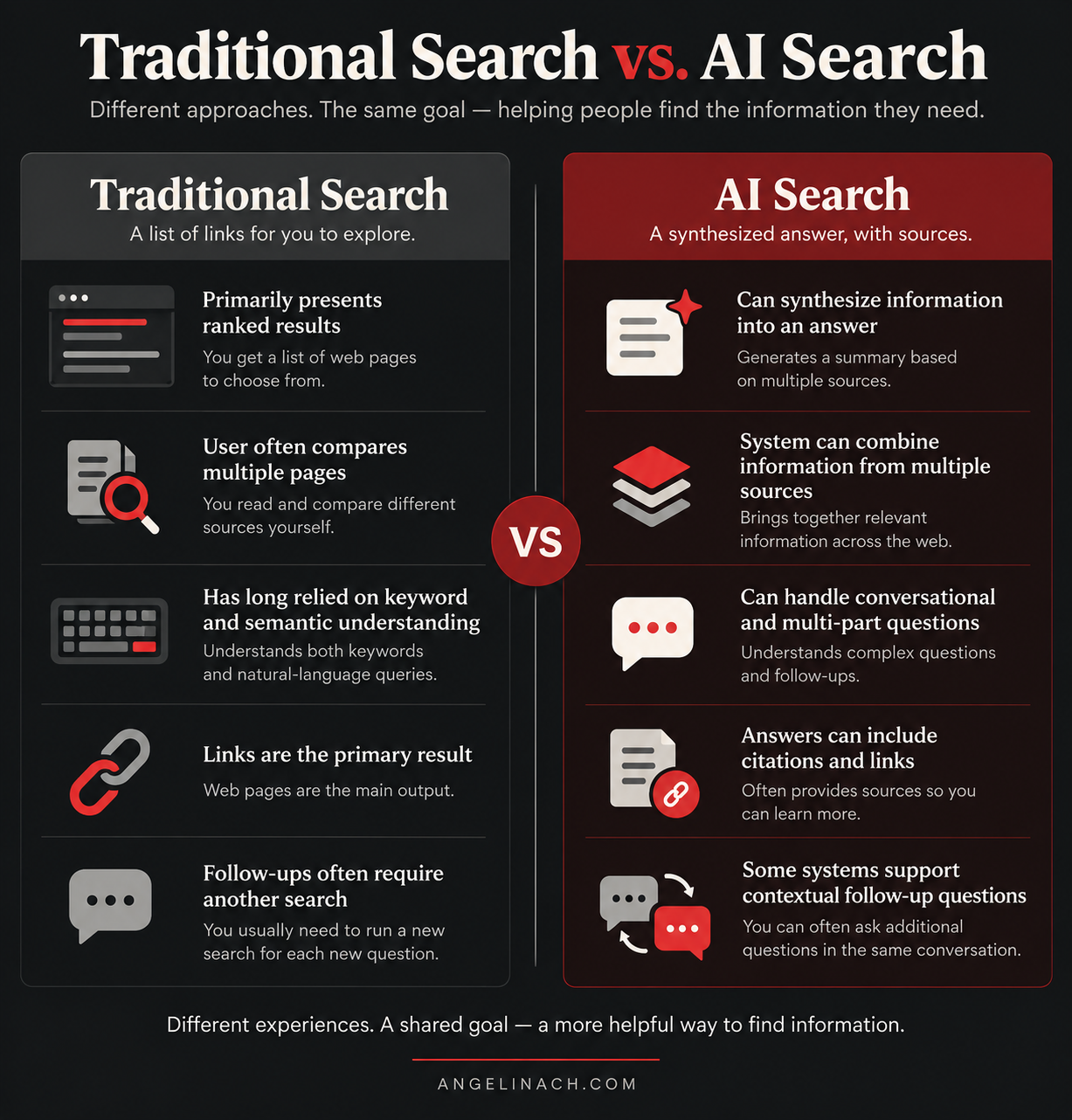
A ranked list asks you to do the comparing. A synthesized answer does some of that work up front, while still, in most cases, pointing you toward the sources it drew from.
3. How Does AI Search Work?
The exact mechanics vary by platform, but at a conceptual level, you can think of an AI search experience as a rough sequence:
User question → understand the query → retrieve relevant information → select/evaluate sources → generate the response → citations and links.
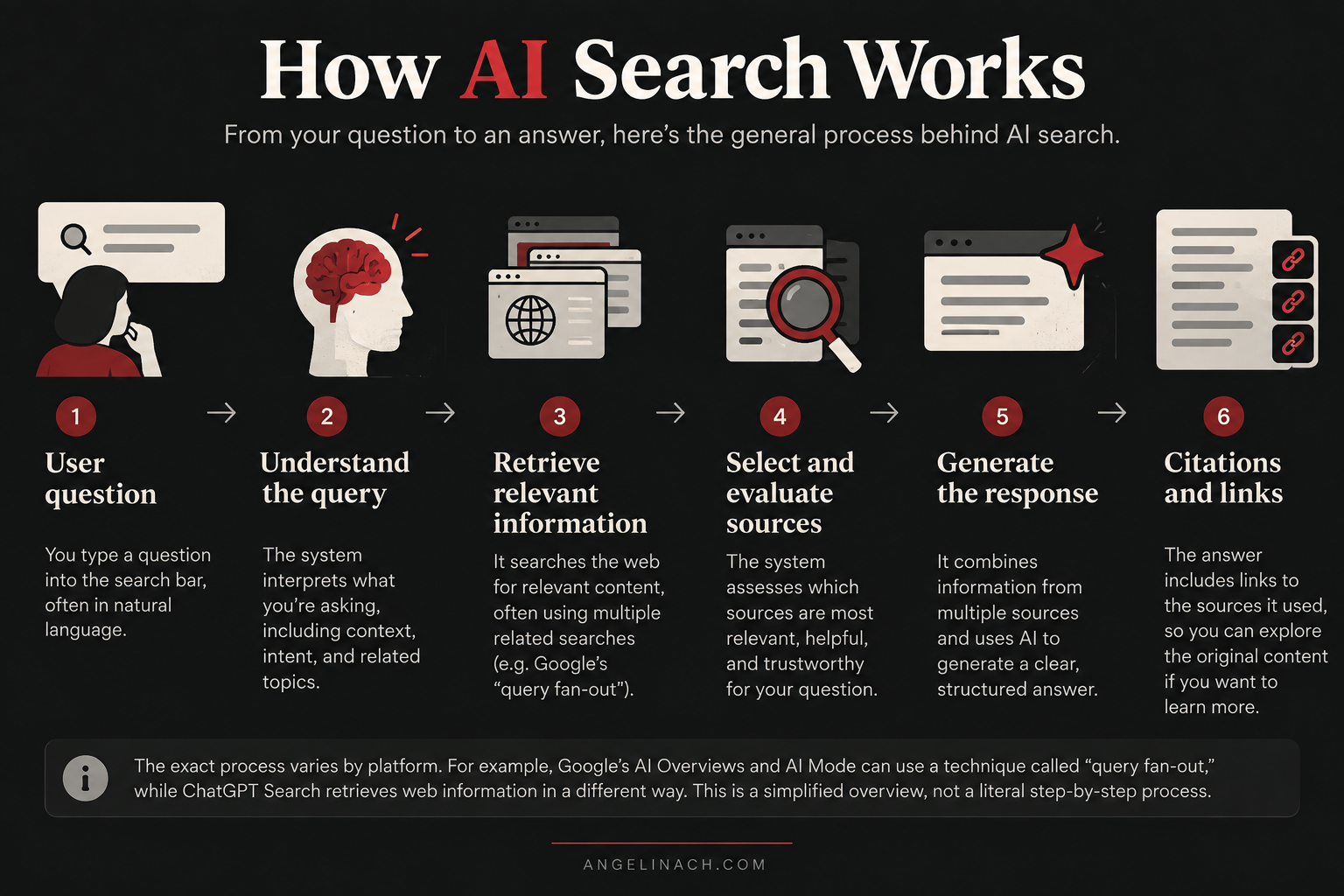
Google describes something similar for its own AI Overviews and AI Mode, both of which can use a technique it calls “query fan-out” — issuing multiple related searches across subtopics before pulling a response together. That’s a Google-specific technique, not a universal description of how every AI search platform works. ChatGPT Search, for example, can retrieve web information and provide sources without necessarily using Google’s approach.
4. What Are Some Examples of AI Search?
Google AI Overviews show AI-generated summaries at the top of some results, when Google’s systems judge a summary adds value beyond a standard results page. Google AI Mode is a separate tab for complex, multi-step questions, with support for follow-ups.
ChatGPT Search is OpenAI’s web search capability inside ChatGPT, triggered automatically or manually, returning an answer with a “Sources” section. Perplexity is built around this model from the ground up: ask, it searches, and returns a synthesized, cited answer as its core product.
5. Is ChatGPT an AI Search Engine?
Not exactly. Although it can provide an AI search experience.
ChatGPT is a general-purpose AI assistant, and it can answer without searching the web at all, drawing on its existing knowledge rather than retrieving information from the web.
When web search is used, automatically for time-sensitive questions, or manually when triggered, ChatGPT can incorporate current information retrieved from web sources, with links back to where it came from.
So ChatGPT shouldn’t be treated as a traditional search engine. But when it’s searching the web to answer you, it’s doing what AI search does.
6. Why Does AI Search Matter for Websites?
When an AI search system generates an answer, the websites it draws from can become sources, citations, and links — a path for someone to click through and read more. Google has reported that clicks from AI Overviews can be higher quality, with users more likely to spend time on the site they visit. It’s also true that some people get what they need from the answer and never click through. That varies by query, platform, and intent.
What doesn’t hold up is claiming AI search will definitely tank traffic, or that nothing has changed. These systems still retrieve information from the web, so being accessible, relevant, and useful remains important for websites that want to be discovered and cited.
7. What Does AI Search Mean for Bloggers?
This is the part that actually matters day to day. Mostly the same fundamentals that have mattered for a while, not a hidden algorithm to chase:
- Make your topic clear.
A reader— human or system — should be able to tell what a page is about within the first few lines. - Answer important questions directly.
Don’t bury the useful part beneath a long preamble. - Use descriptive headings.
Clear structure helps both a human skim and a system understand a page’s organization. - Support factual claims.
Point to reliable sources rather than stating things with nothing behind them. - Add first-hand experience.
Generic information exists everywhere; what you actually did or tested doesn’t. - Create original value.
Restating what a dozen other sites say isn’t adding much. - Build related content.
Internal linking and covering a topic from multiple angles keeps a site coherent. - Make the site and author understandable.
A clear About page and visible authorship help. - Maintain the technical foundation.
Crawlability, indexing, and mobile usability still matter — Google’s guidance says there are no additional technical requirements or special schema needed for AI Overviews or AI Mode beyond the standard requirements for Google Search.
None of this is a list of AI-search hacks. It’s the same advice good SEO has offered for a while, and it applies just as much now as it did before.
8. Where Do SEO, AEO, and GEO Fit In?
You’ll increasingly see three acronyms: SEO (Search Engine Optimization), AEO (Answer Engine Optimization), and GEO (Generative Engine Optimization). Loosely: SEO covers traditional rankings, AEO covers direct-answer formats, and GEO covers generative AI systems. In practice, these overlap heavily and aren’t used consistently across the industry. Worth knowing, not worth treating as three separate rulebooks.
Common Misconceptions About AI Search
- “AI search has replaced traditional search.”
It hasn’t. AI features are part of Google Search now, and ranked results are still there. - “AI search means ChatGPT.”
It’s one example among several, alongside Google AI Overviews, AI Mode, and Perplexity. - “Websites don’t matter anymore.”
AI search systems still retrieve information from the web, so websites remain part of the ecosystem these systems draw from. - “You need special GEO markup.”
Google states there are no additional technical requirements, special schema, or new machine-readable files needed to appear in AI Overviews or AI Mode. - “You should create lots of AI-optimized pages.”
Mass-producing thin content to manipulate AI systems tends to work against you, not for you.
FAQ
What is AI search?
A search experience that uses AI to understand a question, pull in relevant information, and generate a response — often with citations and links to sources.
How does AI search work?
Roughly: interpret the question, retrieve relevant information, evaluate sources, and generate an answer with links back to where it came from. Specifics vary by platform.
What is the difference between AI search and traditional search?
Traditional search primarily presents ranked results for you to evaluate. AI search can synthesize information into an answer while still linking to sources. The two increasingly overlap rather than functioning as completely separate systems.
Is ChatGPT an AI search engine?
Not exactly. ChatGPT is a general-purpose AI assistant that can answer without web search. When ChatGPT Search retrieves current web information, that part of the experience functions as AI search.
Bottom Line
AI search changes how people discover and consume information. That part’s real. But it doesn’t eliminate the fundamentals of running a good website: useful content, clear structure, trustworthy information, first-hand experience, and a technically sound site still matter, because these AI search experiences still draw on information from the web.
The more useful question for most bloggers isn’t “how do I rank in ChatGPT. It’s what you can actually do to make your site more visible and useful across these search experiences.
That question leads naturally into AI search optimization, AEO, and GEO.