Coming up with YouTube video ideas usually isn’t the hard part, because you can just brainstorm twenty topics in ten minutes. The harder question is deciding which of those ideas are actually worth researching, scripting, and producing, versus which ones just sound good on a sticky note.
This article walks through a practical process for going from “I have a channel and no idea what’s next” to a specific video idea you can actually defend.
1. Start With Your Channel and Audience
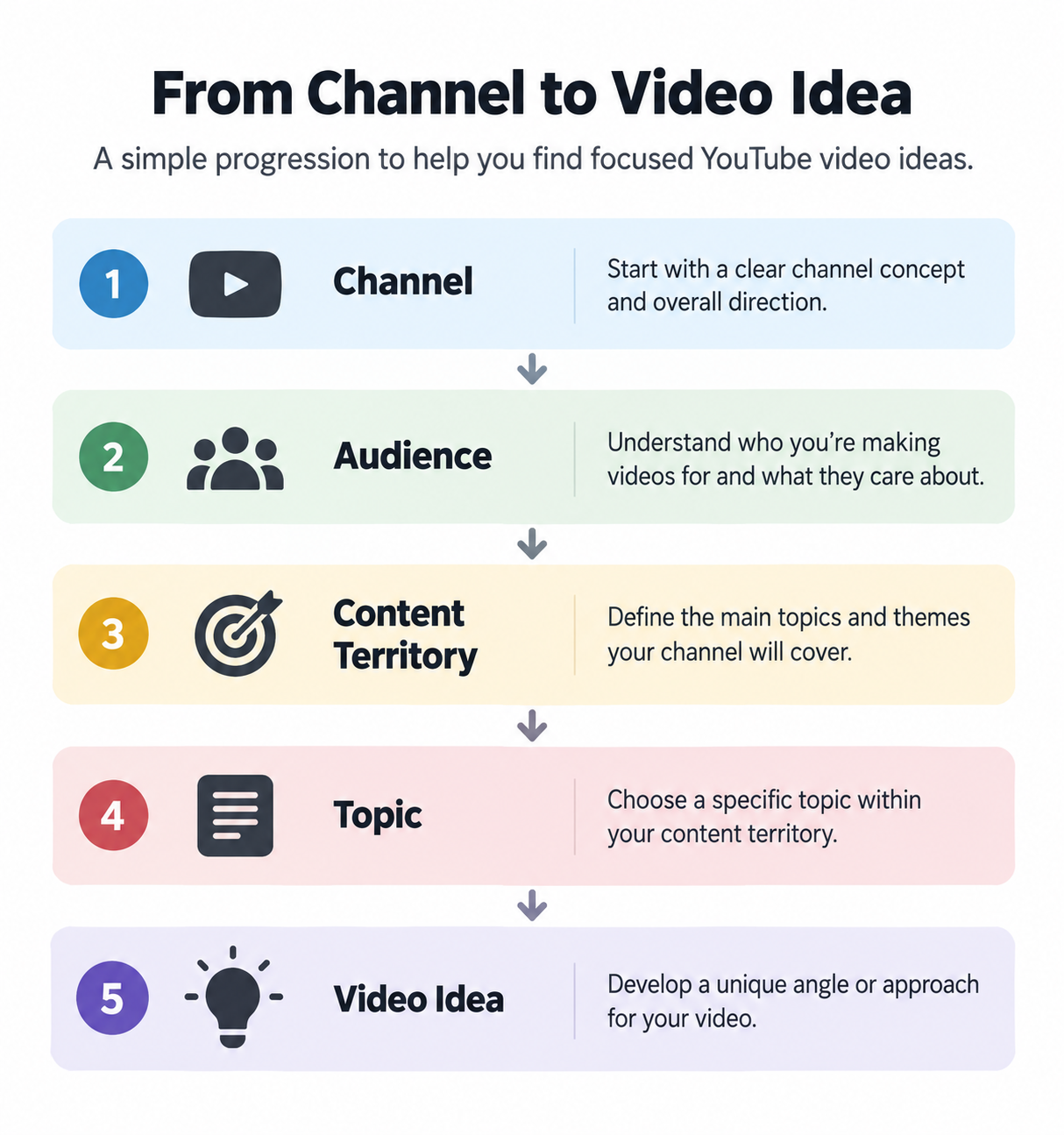
Good video ideas come from a chain: channel → audience → content territory → individual video. They don’t come from a random list.
If your channel covers relationship psychology, an idea should fit inside that territory somewhere, even with a fresh angle. Pull topics from unrelated territory just because they look popular, and you end up with a channel nobody can predict, which makes it harder to build a returning audience.
If you haven’t settled on a channel concept yet, that’s worth working out first, before individual video ideas. I covered this in 20 Faceless YouTube Channel Ideas to Consider in 2026.
Once you know your territory, a few example video ideas across different formats can help illustrate the range available:
- Explainer: “Why We Procrastinate Even When We Know Better”
- Comparison: “Faceless Channel vs. On-Camera Channel: Which Fits You”
- Case study: “What Happened When I Tracked My Channel’s Outlier Videos”
- Story: “The Small Topic That Turned Into a Much Bigger Story”
- List: “Five Signs a Topic Is Worth Researching Further”
These are starting points for your own angle, not templates to copy.
2. Research What Is Already Working
Once you know your territory, look at what other channels in that space are actually publishing. Don’t limit this to the biggest names. They often succeed partly on accumulated authority a newer channel hasn’t built yet. It’s more useful to check established mid-size channels, smaller channels still finding their footing, recent uploads rather than all-time top videos, and topics that keep reappearing across unrelated channels.
Look for Potential Outlier Videos
Within that research, watch for potential outlier videos. It is ones that appear to perform significantly better than a channel’s usual range. A large view count alone doesn’t tell you why a video worked. The useful part is investigating what was different.
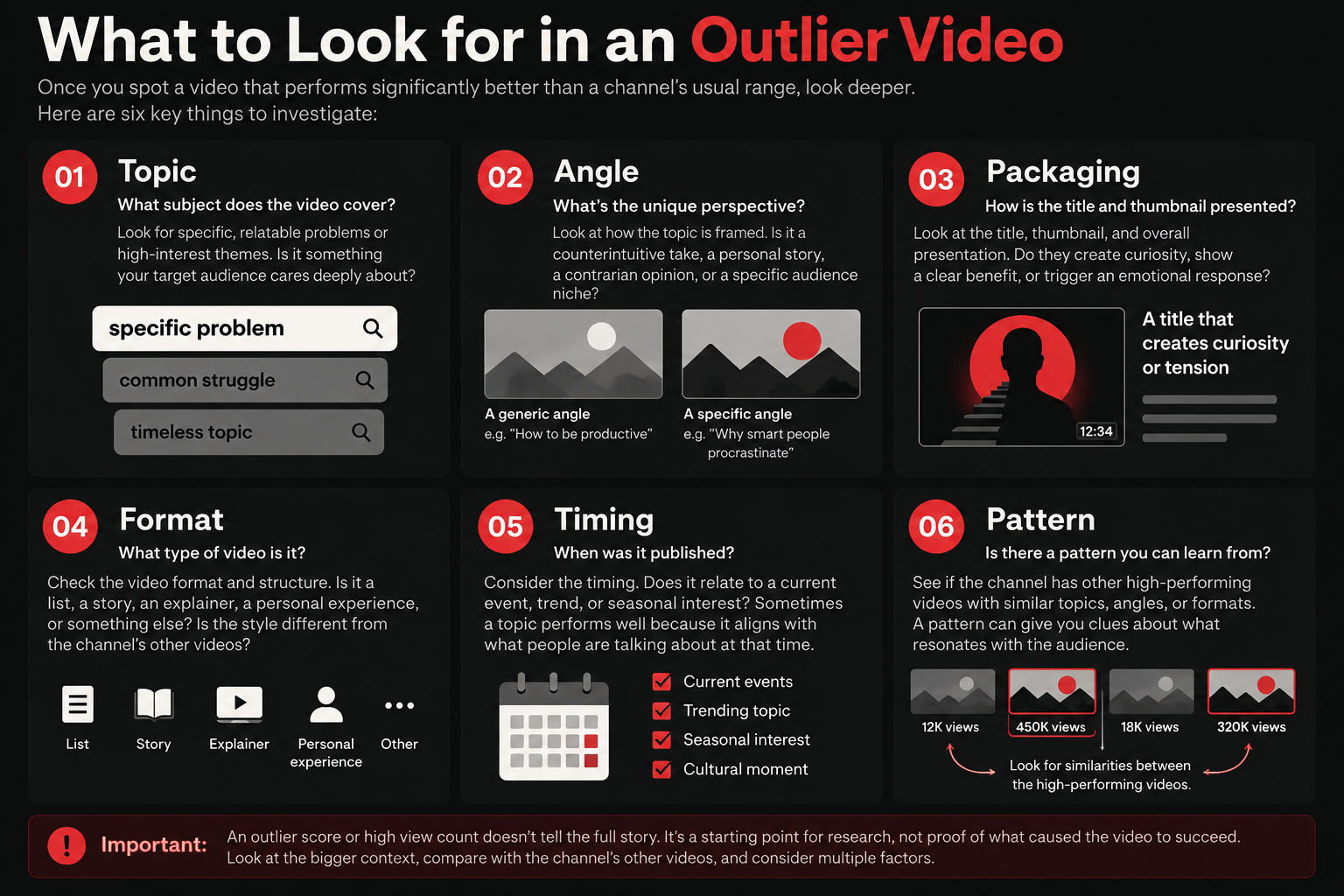
Look at the topic, angle, packaging, format, timing, and whether you can see a broader pattern. For example, a video might stand out because it addresses a specific problem, frames a familiar topic in an unexpected way, or packages the idea more effectively than the channel’s other uploads.
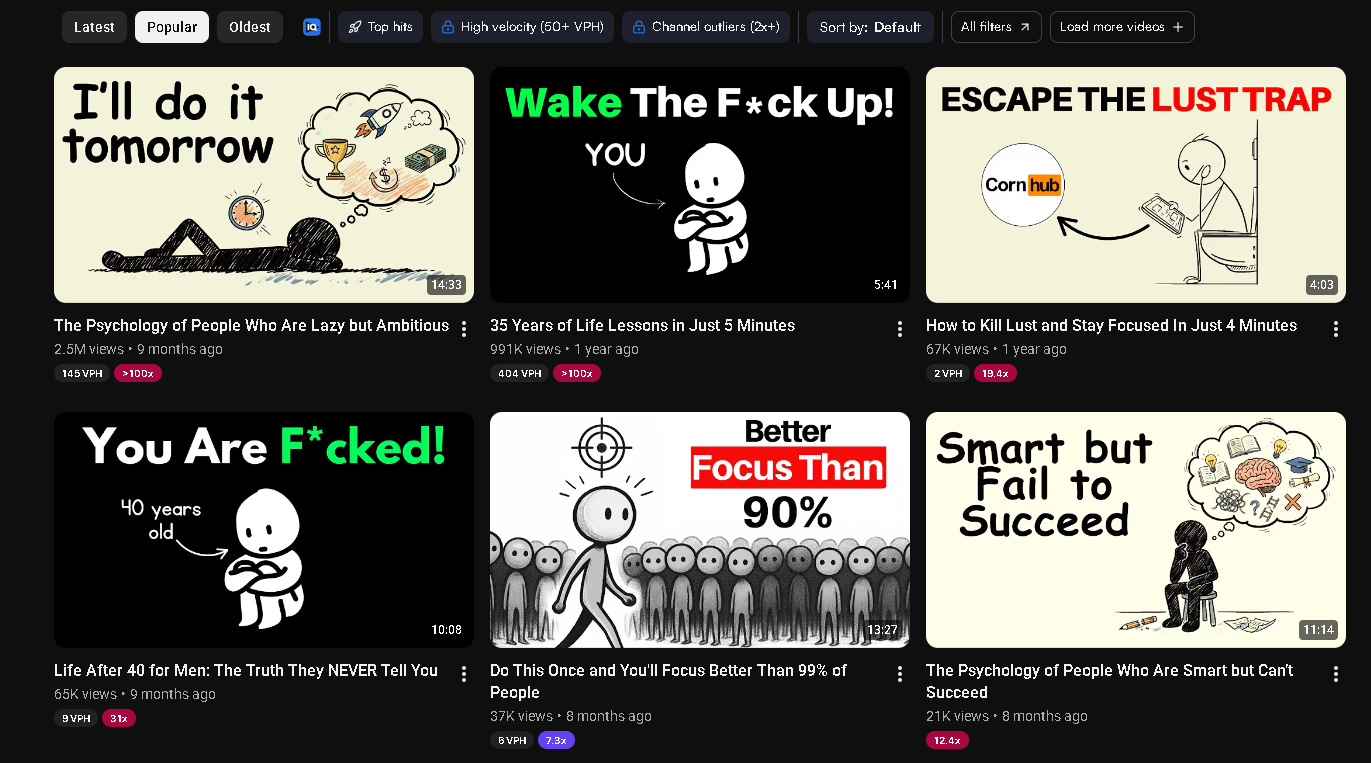
The screenshot above is a useful example. Several videos on this channel are flagged by vidIQ as significant outliers, including videos with 100×+ outlier scores. Rather than assuming the score explains the video’s success, use it as a signal to investigate further. What did these videos have in common? Which topics or angles appeared repeatedly? And were there patterns that could inspire a different video on your own channel?
An old viral video also isn’t automatic proof that the topic is still an opportunity today. Check recent uploads on the same subject before assuming the moment still applies. If a topic performed well three years ago but nothing similar has landed recently, that may mean the moment has passed, or that the format needs rethinking rather than repeating as-is.
This kind of research is about identifying patterns and opportunities, not copying. I learned that the hard way: early on, I reused a larger channel’s exact title for one of my own videos, and my account was banned shortly afterward. I don’t know whether that channel reported it or whether the duplicate title was actually the cause, but it was enough to convince me that competitor research should shape your thinking, not your exact wording.
3. Use Search and Keyword Research as Supporting Evidence
YouTube’s own search bar is one of the simplest research tools available. Typing a broad phrase and watching autocomplete narrow it down shows what people are actually searching for. For example, “faceless youtube” narrowing to “faceless youtube channel ideas,” or “psychology” narrowing to “psychology relationships.” That said, autocomplete is a discovery signal, not proof a video will perform. It shows what people search for, not what they’ll watch.
Keyword research can help you understand what people search for, but it cannot tell you whether a video about that topic will get views. YouTube search behavior is only one part of how viewers discover videos.
A few tools can support this kind of research, each with a different job:
| Tool | Best use | Limitation |
| YouTube autocomplete | Real search phrasing, quick discovery | No volume data, limited depth |
| Google Trends | Interest over time, seasonality | Relative interest rather than absolute search volume |
| Google Keyword Planner | Rough sense of search demand | Built for Google Search ads, not YouTube |
| vidIQ / TubeBuddy | YouTube-specific keyword and competitor data | Features and plans change |
| YouTube Analytics | Understanding your own audience | Only useful once you have upload history |
These are pieces of a broader research workflow, not a shortcut around it. The tool generates data; you still have to decide what it means.
4. Look for the Opportunity, Then Create Your Own Angle
A topic is not the same thing as a video idea. A content gap doesn’t necessarily mean nobody has made the video. More often, it means existing videos leave room for a clearer, more current, or more useful answer. That can look like outdated information, explanations that are accurate but hard to follow, videos that skip beginner-level context, questions repeated in the comments that never get answered, weak visuals, or one-sided coverage of a topic with more than one reasonable perspective.
Comments sections are often the most direct source of this. They show exactly what viewers wanted and didn’t get.
Once you’ve found a real opportunity, the same broad topic can still become very different videos depending on the angle. Take “Why We Procrastinate”:
- Why Procrastination Feels So Rational
- Why Knowing What to Do Doesn’t Make You Do It
- The Hidden Reward Behind Procrastination
Same subject, three different videos. A stronger idea comes from understanding what already exists and finding your own way into it. Through your own research, examples, and conclusions, not from reframing a competitor’s video with different words.
5. Make Sure You Can Actually Produce It
An interesting idea isn’t automatically a good idea for your channel, especially for faceless channels, where production depends heavily on available visuals rather than filming yourself. Before committing, it’s worth asking:
- Can I research this properly, or am I out of my depth?
- Can I find usable visuals or footage, and can I legally use them?
- Can I write a script that says something worthwhile?
- How much time will this realistically take to produce?
- Can I repeat this format? Could I make 20, 50, or 100 videos around this broader concept?
- Does this give me room to add my own perspective or treatment?
An idea that requires resources or licensing you don’t have isn’t a bad idea in the abstract — it’s just not a good idea for your channel right now.
6. A Simple YouTube Video Ideas Validation Checklist
Once you have a candidate idea, run it through a short set of questions:
If most of the answers are positive, the idea deserves further development. That still doesn’t guarantee performance.
Here’s what the whole process looks like starting from something too broad to be useful — “psychology video”: search YouTube for related terms and see what autocomplete suggests, look at several psychology channels rather than just the largest ones, find an outlier (say, a mid-size channel with a video that noticeably outperformed its usual views on one-sided attraction), check whether similar recent videos are still landing, read the comments for a recurring unanswered question, and develop an angle around that specific gap. If it’s something you can realistically research and script, you land on a concrete concept — something like “Why You Keep Wanting Someone Who Doesn’t Want You.”
The point is to show the process: topic → research → evidence → gap → angle → video idea, not to claim this exact topic will perform for any given channel.
7. Don’t Let AI Choose Your Channel’s Ideas for You
AI is genuinely useful in this process — for brainstorming variations, organizing research notes, generating questions to investigate, exploring possible angles, and clustering related ideas. I’ve covered some of these tools in more detail in Best AI Tools for Content Creation in 2026.
What AI can’t do is decide for you whether a topic is genuinely interesting, whether there’s real evidence of audience interest, whether it fits your channel, whether you can produce it properly, or whether your final angle is actually original. Use AI to expand the pool of possibilities and speed up your evaluation — use your own research and judgment to decide what belongs on your channel.
FAQ
What are good YouTube video ideas? Ideas that fit your channel’s existing content territory, show some evidence of audience interest, and offer an angle that isn’t already well covered.
How do I find YouTube video ideas? Study competitor channels, watch for outlier videos, use YouTube search and keyword tools as supporting evidence, and read comments to spot gaps in existing coverage.
How do I know if a YouTube video idea is good? Run it against a short checklist: audience fit, evidence of demand, production feasibility, and a genuinely original angle.
Can AI generate YouTube video ideas? Yes, and it can help you organize your evaluation too, but the ideas still need to be validated against real research before you produce them.
Bottom Line
Good YouTube video ideas aren’t simply ideas that sound interesting. They’re ideas supported by some evidence, that fit your channel and audience, that have a realistic production path, and that leave room for your own angle.
You don’t need to predict which video will go viral, nobody can reliably do that. You need a repeatable way to decide what’s actually worth making next.