
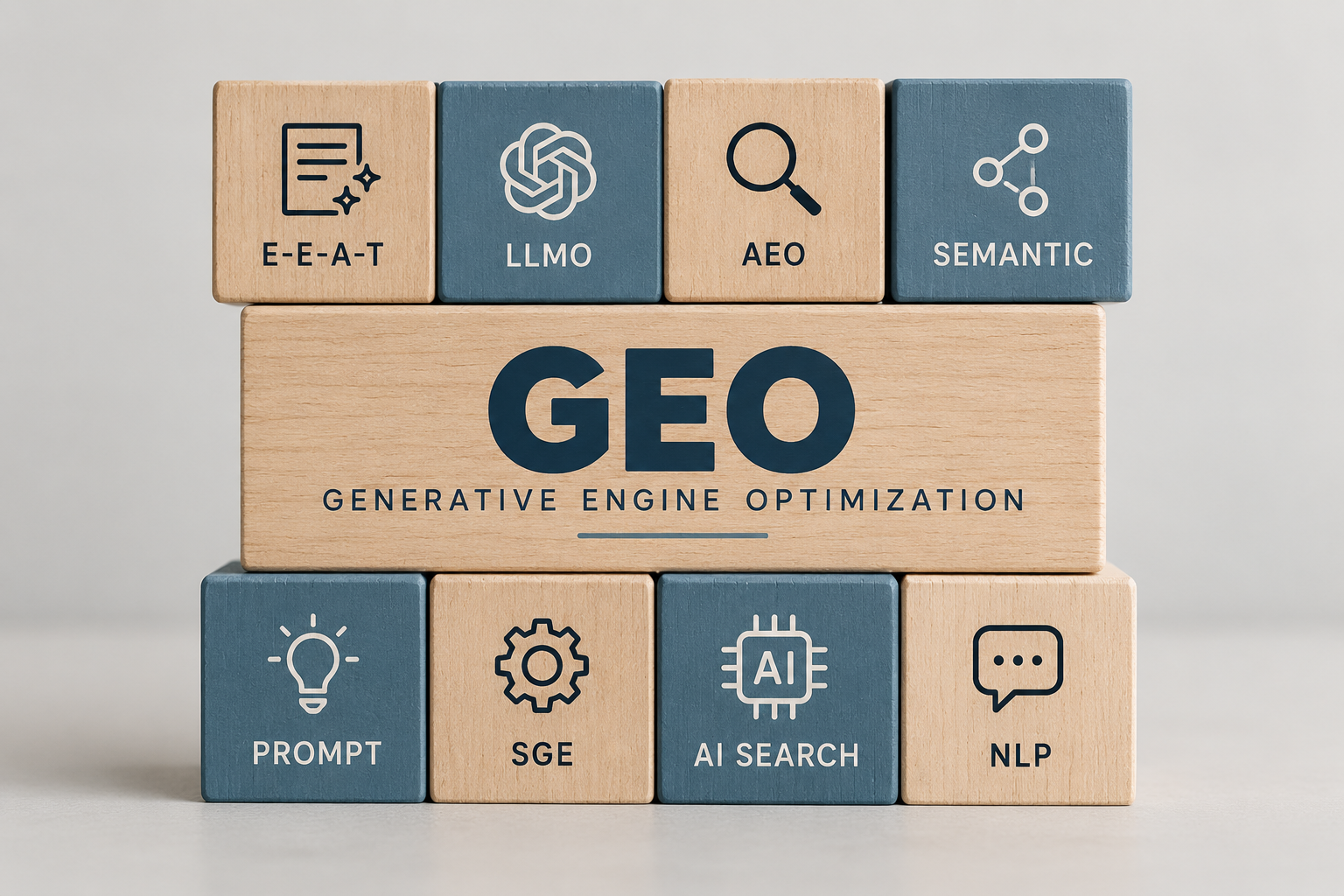
Generative engine optimization (GEO) is the practice of helping AI systems discover, understand, and cite content in their generated answers. As more people use tools such as Google AI Overviews, ChatGPT Search, and Perplexity to research questions, bloggers are paying closer attention to how their content appears in AI-powered search.
That shift has brought generative engine optimization (GEO) into the blogging conversation. But the advice surrounding it isn’t always as well-supported as it sounds.
GEO generally refers to practices that help AI systems discover, understand, and cite content in their generated answers. The term was proposed in a 2023 research paper, but that research shouldn’t be treated as a definitive guide to how today’s search and AI systems select sources.
For bloggers, the practical question is simpler: how can you make your content useful, trustworthy, and discoverable without chasing unproven optimization tricks?
This guide looks at what GEO means, how it overlaps with SEO, and what bloggers can realistically do about it.
If you want a broader explanation of how these systems work, see What It Is, How It Works, and What It Means for Bloggers.
1. How Is Generative Engine Optimization (GEO) Different From SEO?
Generative engine optimization doesn’t replace SEO. The two overlap heavily. SEO focuses on helping search engines discover, understand, and rank relevant content. GEO describes efforts to help AI systems find and use a website as a source in their generated answers.
Google’s guidance reinforces this overlap: its AI search features rely on existing Search systems and SEO fundamentals. No set of GEO tricks guarantees that AI systems will feature your content in their answers.
2. Why Does Generative Engine Optimization Matter for Bloggers?
GEO is worth understanding because people increasingly use AI-powered search experiences to research questions and discover information. Your content may appear as a source in an AI-generated answer, rather than only as a conventional search result.
But visibility doesn’t automatically translate into website visits. A reader may see your site’s name or a link in an answer without clicking through. The impact also varies by query, platform, and website.
For bloggers, that makes GEO worth paying attention to—but not worth treating as a guaranteed source of traffic or a reason to abandon traditional SEO.
3. 3. How Can Bloggers Improve Their GEO?
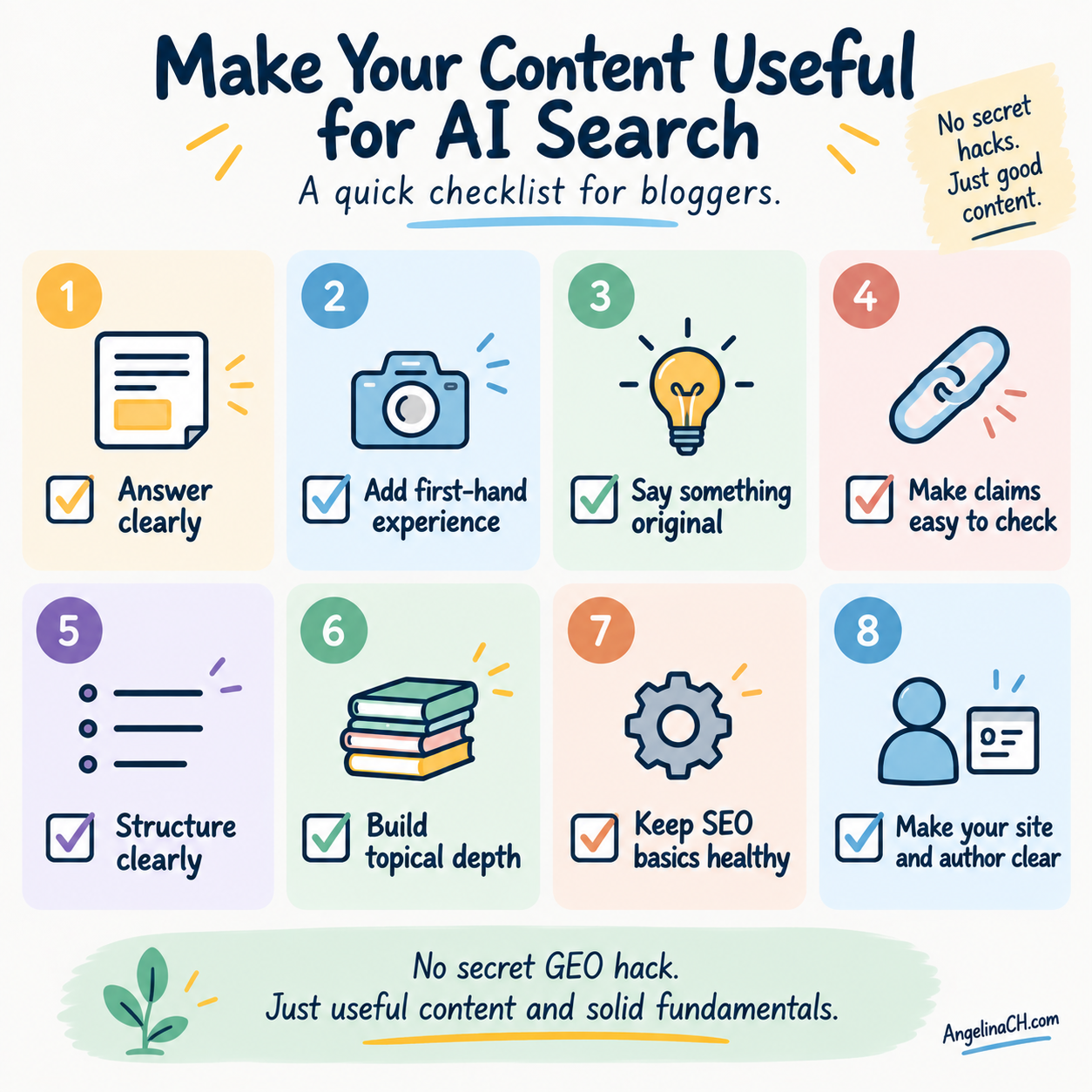
GEO doesn’t require a completely different approach to creating content. Much of the practical work is familiar: make your article useful, explain the subject clearly, support important claims, and give readers a reason to choose your page over another result.
Answer the Question Clearly
Put the main answer near the beginning instead of making readers work through several paragraphs of setup. Use as much detail as the question needs; no universal word count guarantees AI visibility.
Add Genuine First-Hand Experience
Include screenshots of processes you’ve actually performed, observations from using a tool, or mistakes you’ve learned from. Don’t invent experience to make an article appear more authoritative.
Offer Something Original
Ask what your article contributes beyond the information already available. You could provide a useful example, a clearer explanation, an original comparison, or a perspective grounded in experience.
Make Important Claims Easy to Verify
Link to primary sources when possible, distinguish facts from opinions, and revisit information that may become outdated. These practices support credibility, even though they don’t guarantee an AI citation.
Structure the Article for Readers
Use descriptive headings, logical sections, and lists or tables when they genuinely improve understanding. Don’t force every paragraph into a formula just because someone calls it AI-friendly.
Build Related Content
Create useful articles that answer related questions, then link them where the connections make sense. This helps readers explore your site instead of leaving them with isolated pages.
Keep the Technical Basics Healthy
Make sure search engines can crawl and index important pages. Add helpful internal links and keep essential information available in text. For Google’s AI search features, Google must index a page and consider it eligible for regular Search before it can consider the page for AI Overviews or AI Mode.
Make Authorship and Site Information Clear
Maintain an accurate About page, identify authors appropriately, and explain your site’s purpose clearly. These are sensible trust and usability practices—not a special GEO formula.
4. Do You Need Special GEO Markup or an llms.txt File?
No special GEO schema is required for Google’s AI search features. Google says the same SEO fundamentals apply, and you don’t need to add special machine-readable files or AI-specific markup to become eligible for AI Overviews or AI Mode.
Structured data can still be useful when it accurately describes content on the page and follows Google’s guidelines. It shouldn’t be treated as a hidden signal that guarantees an AI citation.
The same caution applies to llms.txt. Don’t assume that creating this file will improve your Google Search visibility. If another platform or tool supports it, that may be a separate consideration, but it isn’t a substitute for useful content and sound technical SEO.
FAQ content can still help readers find answers. However, adding FAQ schema shouldn’t be treated as a guaranteed visibility boost. Check Google’s current documentation before implementing structured data solely for a search feature.
5. GEO Tactics You Should Be Skeptical About
A lot of GEO advice repackages familiar SEO practices or presents unproven tactics as guaranteed results. Be cautious when someone promises a shortcut to AI visibility.
- “Just add keywords for AI.” Keywords still help describe a topic, but stuffing phrases into an article doesn’t make it more useful.
- “Add special GEO schema.” Google doesn’t require a separate GEO schema for AI Overviews or AI Mode, and no markup guarantees a citation.
- “Publish hundreds of AI-generated pages.” Producing pages at scale without adding value can run into Google’s spam policies. The issue isn’t simply whether AI was used; it’s whether the content is useful and created for people.
- “Put the answer in exactly 40–60 words.” There’s no universal answer length that guarantees an AI citation. Give the reader the explanation the question actually needs.
- “GEO guarantees citations.” No checklist or service can guarantee that an AI system will select or cite a particular page.
When you encounter a new GEO claim, look for evidence from the platform involved. Google’s guidance on evaluating third-party SEO advice is a useful starting point for claims about Google Search.
6. 6. A Simple GEO Workflow for Bloggers
A practical generative engine optimization workflow doesn’t need to be complicated.
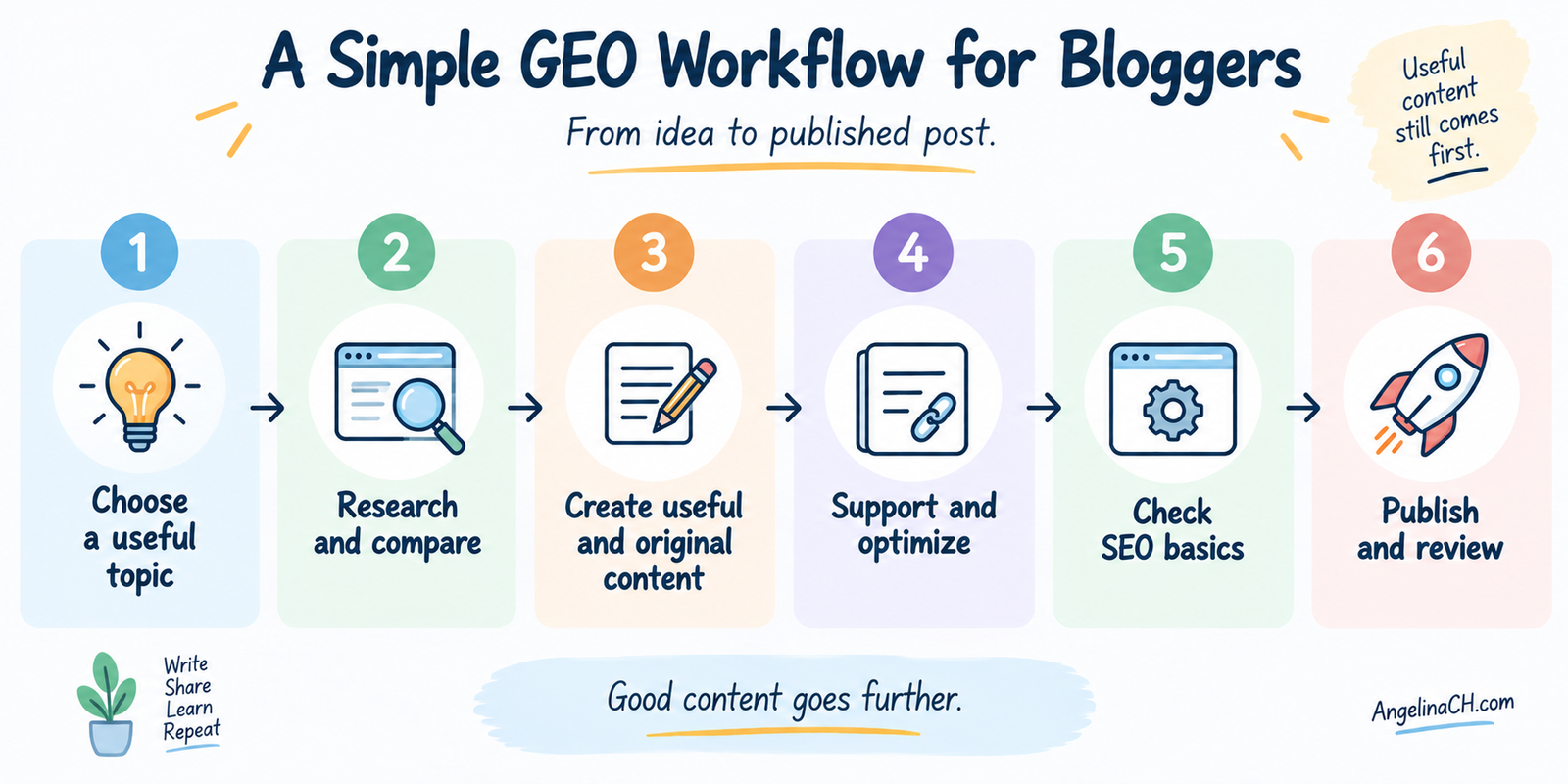
- Choose a topic your audience cares about, and identify the question the article needs to answer.
- Review the search results and, where useful, AI-generated answers to understand what information is already available.
- Identify gaps, then write a clear answer that adds useful detail, original insight, or genuine experience.
- Support important factual claims with reliable sources and organize the article with descriptive headings.
- Link to relevant articles on your site and check that the page can be crawled and indexed.
- Publish, then review available search and referral data periodically. Use what you learn to improve future content instead of obsessing over individual AI answers.
This isn’t a guaranteed GEO formula. It’s a way to apply sound content and SEO practices while paying attention to how search is changing.
7. How Can Bloggers Measure GEO?
Measuring GEO is still different from measuring ordinary website traffic, and the available data depends on the platform.
For Google, Search Console now includes a Generative AI performance report that helps site owners monitor their visibility in features such as AI Overviews and AI Mode. It can show which pages receive impressions in those features, but it doesn’t provide a complete picture of your site’s visibility across every AI tool.
You can also watch for identifiable referral traffic from AI platforms in your analytics tools and check whether your content is being cited when you investigate relevant questions manually. Treat manual checks as snapshots, though: answers can change depending on the question, time, and platform.
For a new blog, don’t expect meaningful conclusions from a handful of observations. Record what you can measure, review it periodically, and avoid treating an occasional citation—or the absence of one—as proof that your strategy is working or failing.
FAQ
Is GEO the same as SEO?
No. GEO is a term commonly used for improving visibility in AI-generated answers, while SEO covers a broader set of practices that help search engines discover, understand, and rank content. The two overlap substantially, and traditional SEO fundamentals remain important for Google’s AI search features.
How do I optimize my blog for ChatGPT?
There is no guaranteed formula. Publish useful, original content, support factual claims, make your site technically accessible, and give readers a clear reason to trust your information. Different AI systems may discover and use sources differently.
Can GEO guarantee that AI will cite my website?
No. No checklist or optimization service can guarantee that an AI system will cite your website. Focus on making your content genuinely useful and discoverable instead of relying on promises of guaranteed visibility.
Bottom Line
Generative engine optimization is a useful way to think about changing search experiences, but it isn’t a separate discipline that makes SEO obsolete.
For most bloggers, the fundamentals remain familiar: answer questions clearly, add something useful and original, support important claims, structure content well, and maintain a site that search engines can crawl and index.
None of these steps guarantees an AI citation. But they help you build a better resource for readers—and that’s a more durable goal than chasing a collection of unproven GEO tricks.